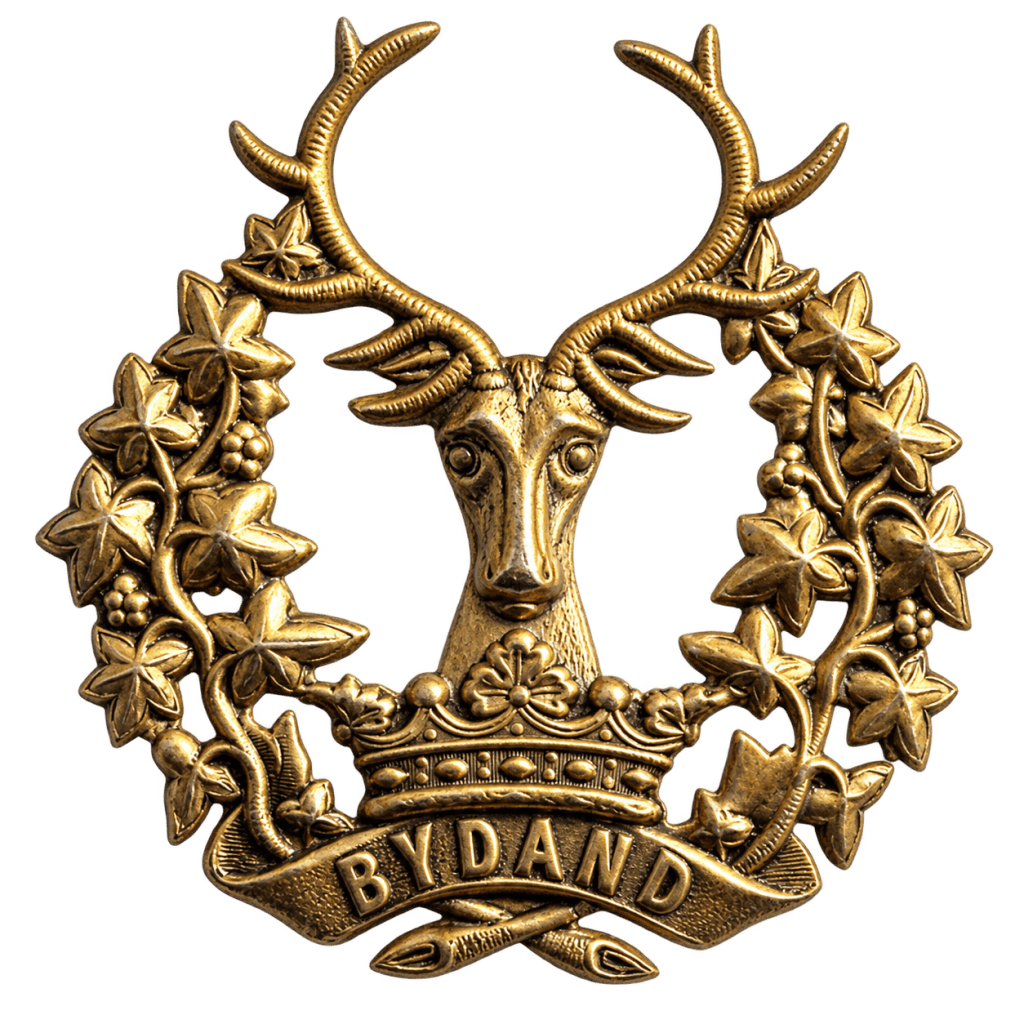
9th Battalion, Gordon Highlanders,
31st July 1917
Synopsis of Life and Military Service
Early Life
William McDonald was born at Grange, Banffshire, on 27 September 1892, the son of John and Isabella McDonald, who later lived at Relugas, Dunphail. He was educated at Knockando.
Unlike many of the men who entered military service following the outbreak of the First World War, William was already a professional soldier. He joined the Gordon Highlanders at Aberdeen in September 1909, when he was just short of his seventeenth birthday.
Service with the Gordon Highlanders
William initially served as Private No. 330 with the 2nd Battalion, Gordon Highlanders. Following the outbreak of war in August 1914, he was sent overseas, arriving in France and Flanders on 7 October 1914.
At some point during his service, although the precise date is presently unknown, William was transferred from the 2nd Battalion to the 9th Battalion, Gordon Highlanders.
The 9th Gordons served as the Pioneer Battalion of the 15th (Scottish) Division. Pioneer battalions combined the duties of infantry soldiers with the demanding physical work required to construct and maintain the infrastructure needed by an army in the field. Their work included constructing and repairing trenches and tracks, laying barbed wire and carrying out other engineering and labouring duties, often under enemy fire.
The Offensive of 31 July 1917
On 31 July 1917, the 9th Battalion took part in the opening operations of what became known as the Third Battle of Ypres.
In his Operational Order for the attack, the battalion’s Commanding Officer, Lieutenant-Colonel T. G. Taylor, D.S.O., outlined the situation facing the 15th Division. The German 17th Division occupied the ground opposite them, with successive defensive positions stretching from the front line through the Stützpunkt and Gheluvelt-Langemarck Lines, while further German reserves were positioned approximately a mile south-west of Passchendaele.
The XIX Corps was to go onto the offensive at Zero Hour as part of the wider operation intended to force the German Army back through its defensive lines.
The role allocated to the 9th Gordons was essential to maintaining the advance. They were tasked with constructing tracks across the battlefield for artillery and horse-drawn transport, as well as preparing a route for a narrow-gauge railway.
Working Under Enemy Fire
At 6 a.m., two hours after Zero Hour, orders were given for work to begin on both tracks. Taping parties were immediately sent forward to mark the routes across No Man’s Land and onwards towards the German Reserve Line.
Conditions were extremely difficult. Heavy artillery fire, including both high-explosive and gas shells, had badly damaged the tracks leading towards Cambridge Road during the preparatory stages of the operation. As a result, neither had been completed before the advance began.
Despite these conditions, the men of the 9th Gordons continued their work, and during the afternoon the track across No Man’s Land was completed as far as circumstances permitted.
The battalion remained exposed to severe enemy artillery fire throughout the day. By the end of 31 July, two Other Ranks had been killed, while one officer and 28 Other Ranks had been wounded.
William McDonald was killed in action that same day, 31 July 1917. Although the precise circumstances of his death are not recorded, it is possible that he was one of the men killed during the heavy German artillery fire to which the 9th Gordons were subjected while carrying out their pioneer work.
He was 24 years old.
Remembered
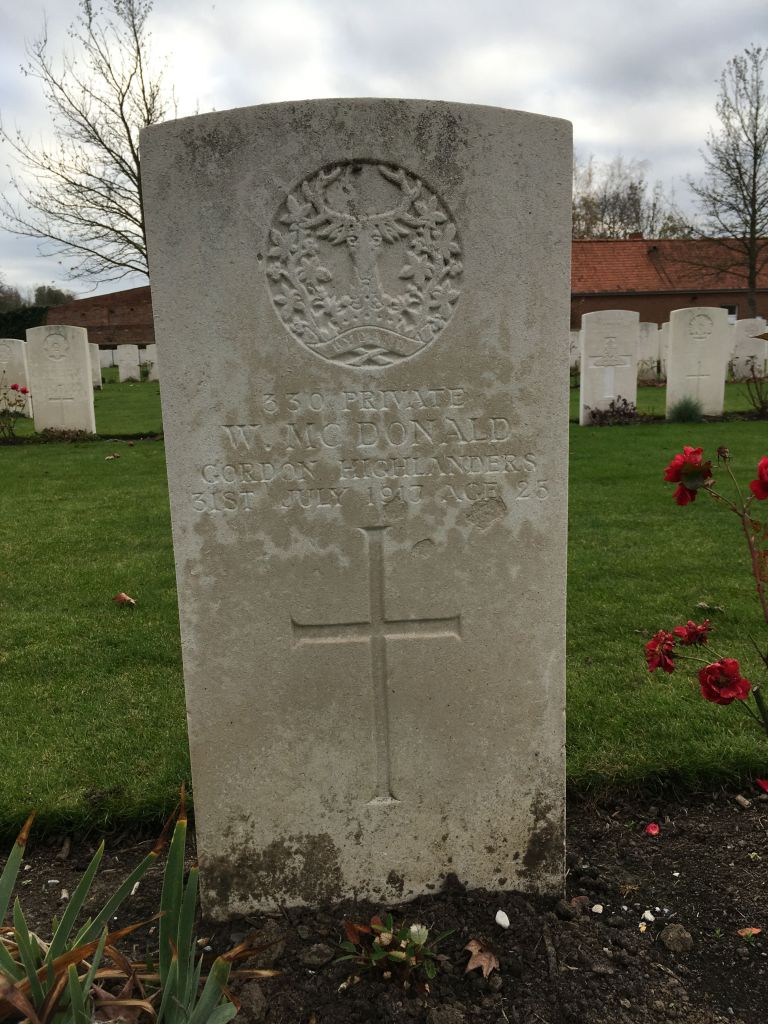
William was subsequently buried in Menin Road South Military Cemetery, West-Vlaanderen, Belgium.
His entry in the Morayshire Roll of Honour, published in 1921, records him as a regular soldier who had joined the Gordon Highlanders in September 1909 and served in France before being killed in action on 31 July 1917.
William had been a soldier for almost eight years and had served on the Western Front since October 1914. His death came while the 9th Gordon Highlanders were carrying out the difficult and dangerous work required to maintain the advance during one of the major offensives of the First World War.
Family
William McDonald was born at Grange, Banffshire, 27th September 1892. The following family information is taken from the 1901 Census and ‘Lives of the First World War website.
His family is shown as follows :-
- Father: John McDonald, born c.1858 at Cromdale, Elginshire – Joiner.
- Mother: Gabella Glass or McDonald, born c.1864 at Mortlach, Dufftown.
- Sister: Annie Jane, born 10 April 1884 at Glenrinnes, Banffshire – Nurse (Domestic).
- Brother: Charles George, born 25 September 1885 at Glenrinnes, Banffshire.
- Brother: James Alexander, born 18 March 1887 at Glenrinnes, Banffshire.
- Sister: Isabella McDonald or Shand, born 25 October 1890 at Glenrinnes, Banffshire.
- Brother: George Lobban, born 30 March 1891 at Grange, Banffshire.
- Sister: Catherine Margaret Sim McDonald or Webster, born 19 November 1895 at Grange, Banffshire.
- Brother: Malcolm, born 4 March 1897 at Grange, Banffshire.
- Sister: Alice, born 11 December 1898 at Mortlach, Banffshire.
- Sister: Helen, born 6 December 1900 at Mortlach, Banffshire.

Addresses
The following addresses have been ascertained for William and his family:-
- 1901: 28 Conval Street, Dufftown, Banffshire. (Census)
- Ballentomb Cottage, Dulnain Bridge, Grantown-on-Spey.
- Rowan Cottage, Dulnain Bridge, Grantown-on-Spey.
- 50 Balvenie Street, Dufftown, Banffshire. (C.W.G.C.)
- 1921: Relugas, Dunphail Estate, near Forres, Morayshire.
Medals
William McDonald was awarded the 1914 Star and Clasp, Victory and the British War Medals for his service in the Great War.
Memorials
William McDonald is honoured and remembered on the following memorials:-
- Glenrinnes and Kirkhill War Memorial, Glenrinnes, Moray. (along with his two brothers)
- Mortlach and Parishioners War Memorial, Dufftown, Moray. (along with his brother Malcolm)

Remarks
His brother James Alexander McDonald was killed in action on the 29th July 1916, while fighting in the Australian Imperial Force.
Soldiers Died in the Great War records William’s place of birth as Keith. However, other evidence gives his birthplace as Glenrinnes, Banffshire, which appears more likely. Keith was an important postal town for the surrounding area, which may account for the discrepancy.
There is also conflicting information regarding his place of enlistment. Soldiers Died in the Great War records Dufftown, while the Morayshire Roll of Honour states that he joined the Gordon Highlanders at Aberdeen in September 1909. Without William’s original enlistment papers, it is not possible to confirm which is correct.
Links to Additional Information
- Commonwealth War Graves Commission: William McDonald
- Lives of the First World War: William McDonald
- A Street Near You website: William McDonald
- Find a Grave: William McDonald
- Morayshire Roll of Honour: William McDonald
- WW1 Lives website: Brother – James Alexander McDonald
References
- Morayshire Roll of Honour.
- Commonwealth War Graves Commission.
- Medal Index Card.
- Medal Roll – Gordon Highlanders – Victory and British War Medal.
- Soldiers Died in the Great War.
- Register of Soldiers Effects.
- War Diary of the 9th Gordon Highlanders.
- Military Pension Card.
Groups
Contributors:-
- Vincent Stuart
- Carlos Aelvoet (Grave Photo)

