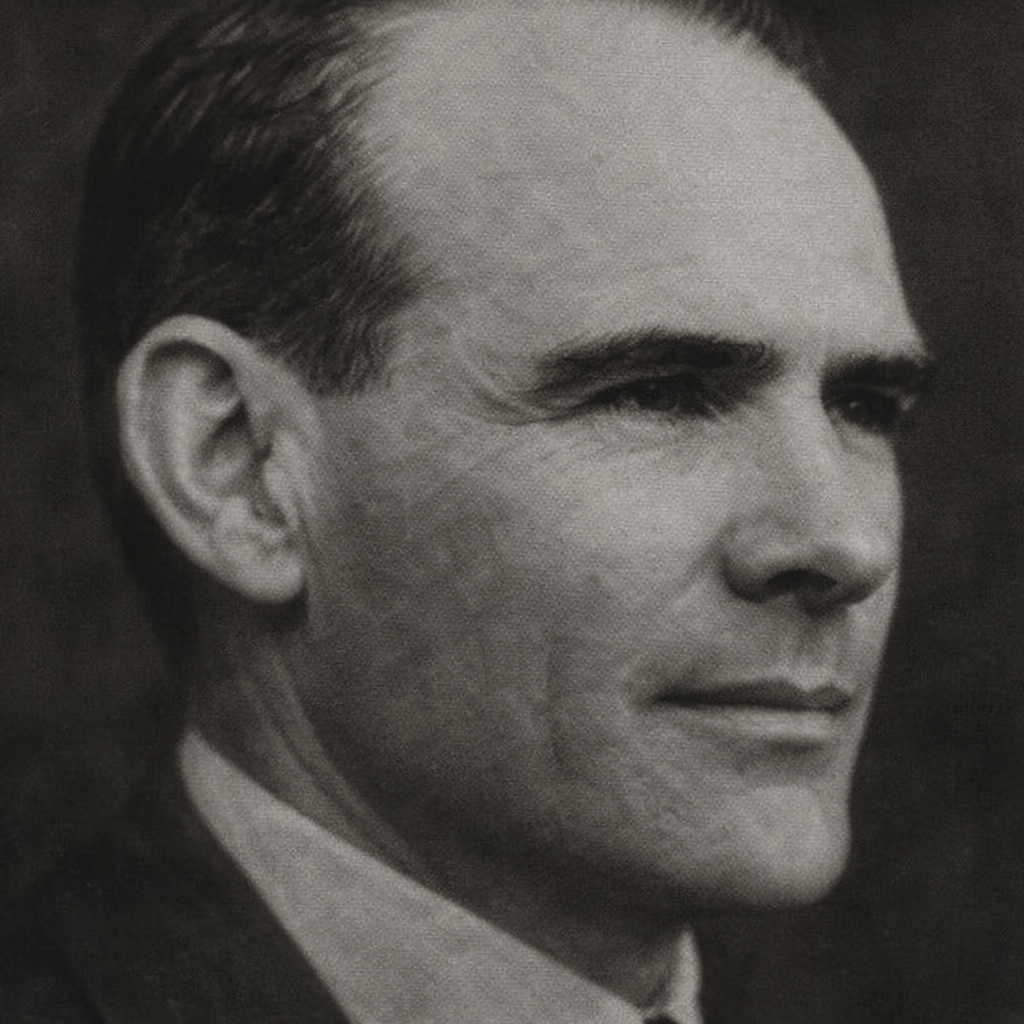
6th Battalion, Seaforth Highlanders,
15 February 1919
Synopsis of Life and Military Service
Early Life (1886–1891)
John Matheson was born 11 January 1886 at Miltonduff, Elgin, Morayshire. Although details about his early life are sparse the following information has been ascertained. At the time of the 1891 Census, John Matheson was listed as a 5 year old living at 263 High Street, Elgin. In the 1901 Census, aged 15 years, he is shown working as a Cattleman at Cairneyhillock, near Elgin.
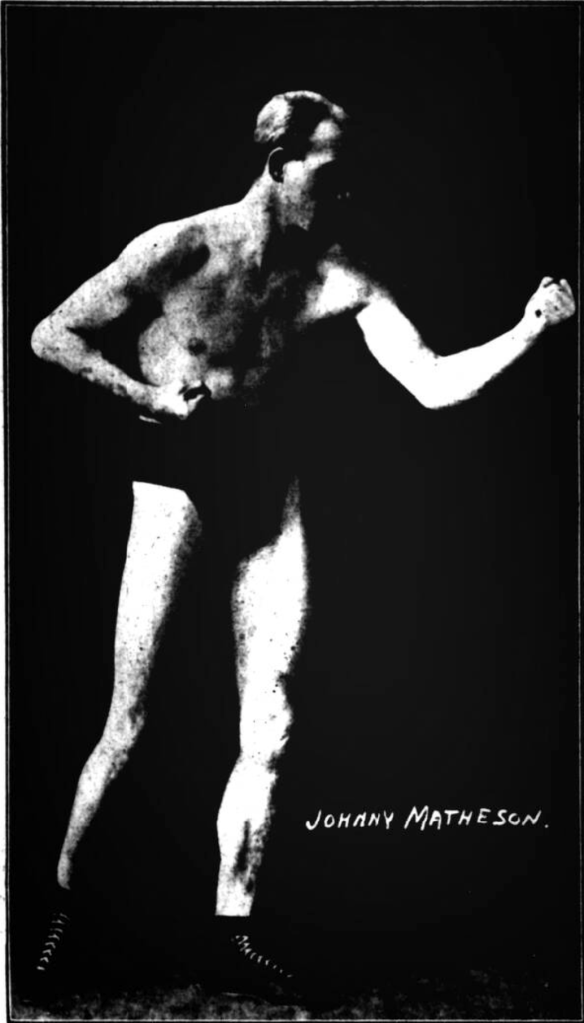
Johnnie “The Fighting Scot” Matheson (pre-August 1914)
Before the First World War, Johnnie Matheson was already well known across Britain and Ireland as “The Fighting Scot,” one of Scotland’s most respected heavyweight boxers.
A former soldier in the Seaforth Highlanders, Matheson first made his name while serving in India, where he developed a formidable reputation as an army boxer. Returning to Scotland in the years before 1910, he quickly became a popular figure in the boxing world, admired for his courage, stamina, and relentless attacking style.
On 31 March 1911, the Aberdeen Press and Journal reported on a much-anticipated ten-round contest between John Matheson and Sid Doyle of London, held at Aberdeen’s Olympia Skating Rink. Such was the public enthusiasm for the bout that around 4,000 spectators filled the venue, while it was estimated that an equal number were turned away, unable to secure admission. Before this sizeable crowd, the contest ran the full ten rounds, ending with Matheson declared the winner on points.
On the 10 April 1911, he married Florence Malone, daughter of Richard Malone, Meikleriggs, Paisley at St. Andrews Parish Church, Glasgow by the Rev. J. Thomson, M.A.
On 18 September 1911, his son Richard John Matheson was born at 51 Windmill Street, Saltcoats, North Ayrshire.
Between 1911 and 1914 he fought many of the leading heavyweight boxers of the day. His opponents included Pat O’Keefe, Pat Breslin, Jem Roche, and the black American Dixie Kid, whom he defeated in Birmingham in 1912 before later drawing with him in London. He also spent time as sparring partner to the Australian heavyweight Bill Lang, further enhancing his standing in British boxing circles.
By 1913 and early 1914 Matheson was still appearing in major contests in Scotland, England, and Ireland, though newspaper reports increasingly suggested that years of hard fighting were beginning to take their toll. This was confirmed in a remarkable letter published in the Northern Scot on 11 July 1914, only weeks before the outbreak of war. Writing with honesty and humility after a defeat in Aberdeen, he admitted that his “best fighting days” might be behind him, attributing his decline to the hardships he had endured. Even so, he remained passionate about boxing and expressed the hope of encouraging young Highland men into the sport.
That letter is especially striking in hindsight. At the very moment Matheson seemed ready to step back from the ring, the outbreak of war in August 1914 transformed his future. As a former regular soldier, he promptly rejoined the Seaforth Highlanders and served in France and Flanders, where he was twice severely wounded.
Enlistment and Front-Line Service (1914–1916)
With the outbreak of war, John enlisted on 21 September 1914 as a Private soldier re-enlisting into the Seaforth Highlanders, 6th Battalion, service number 2420 and following retraining he arrived in the France and Flanders Theatre of War on 1 May 1915. From 12 May 1915, the 1/6th (Morayshire) Battalion was retitled to 152nd Brigade in 51st (Highland) Division.
The Labyrinth and Severe Wounding (March 1916)
In March 1916, the month John Matheson was injured, the Division went into the line from the ‘ruined village’ Neuville St.Vaast to Roclincourt. Through a ‘blinding snowstorm’ the Division had been ordered to head northwards to relieve the 23rd French Division of the XXII Corps d’Armee north of Arras. The area was known as the Labyrinth, due to the close proximity that the French and Germans had dug themselves into creating an ‘unintelligible maze’. When the blizzard subsided, the area around the trenches was described as, ‘a vast cemetery, in which the earth in many places barely covered the dead’. The War Diary for the 6th Battalion Seaforth Highlanders mentions that, between 12th and 17th March, they suffered ‘constant bombing’. On 13th March 1916 John was severely wounded in the neck.
John Matheson was noted in the Dundee Courier, 28th March 1916, as being wounded for the second time. However, it was feared that his wounds received in Spring 1916 were more serious than previous wounds. In this same article, John Matheson is recorded as taking part in an exhibition boxing tournament, which took place ‘behind the firing line.’
Hospital Treatment and Discharge (1916)
Between 1st April and 4th July 1916, John Matheson was admitted to Norfolk War Hospital with a gun shot wound to his lower jaw. The injury was confirmed as being caused by a grenade damaging him on his, ‘right side especially through [his] chin and neck implicating tongue… at Norwich he was operated upon and a piece of a grenade was taken out of his neck near the base of his tongue.’ The same medical report records that John had, ‘a history of gonnorhea but he maintains he never had syphilis.’
John Matheson was discharged on 13th October 1916 following his injuries, which were serious enough to describe him, a professional athlete, as ‘permanently unfit.’ He was recorded as 30 years old, grey eyes, dark hair, and of ‘very good’ military character.
Attempted Return to Service (1917)
Between 20th July 1917 and 29th August 1917, John Matheson was employed by the Royal Engineers, Inland Waterways and Transport, service number 306106, but was discharged due to wounds. From this we can speculate that John Matheson made an attempt at service following his initial discharge from the 51st (Highland) Division following his wounding in March 1916, however it did not last long.
Death and Burial (1919)
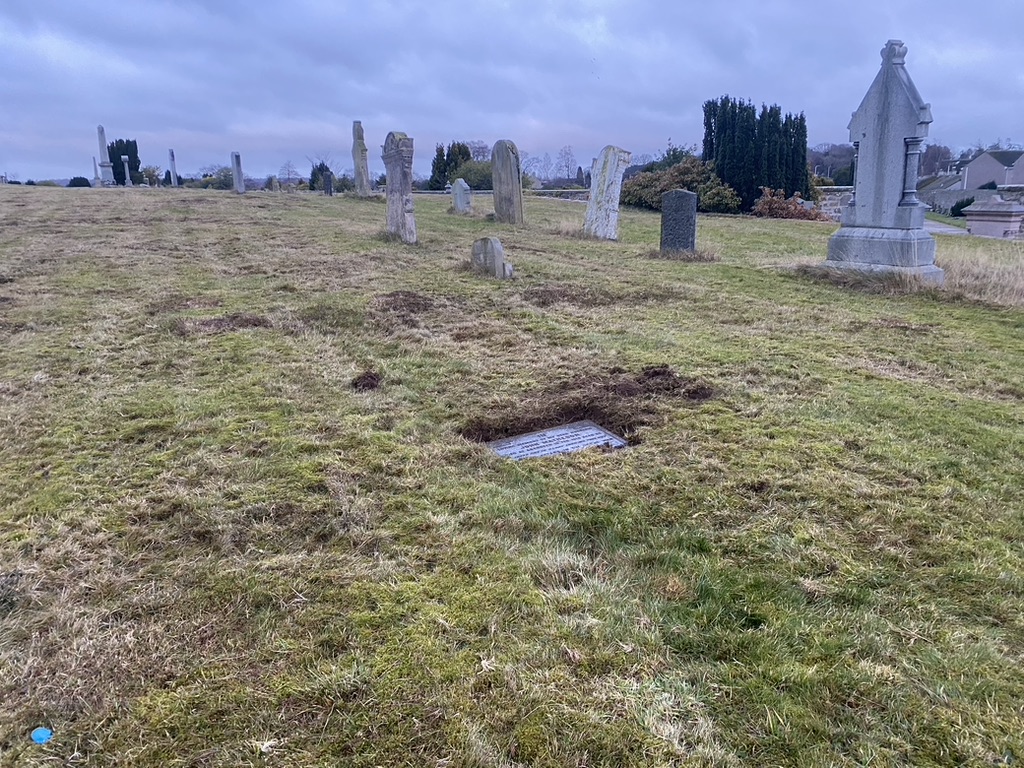
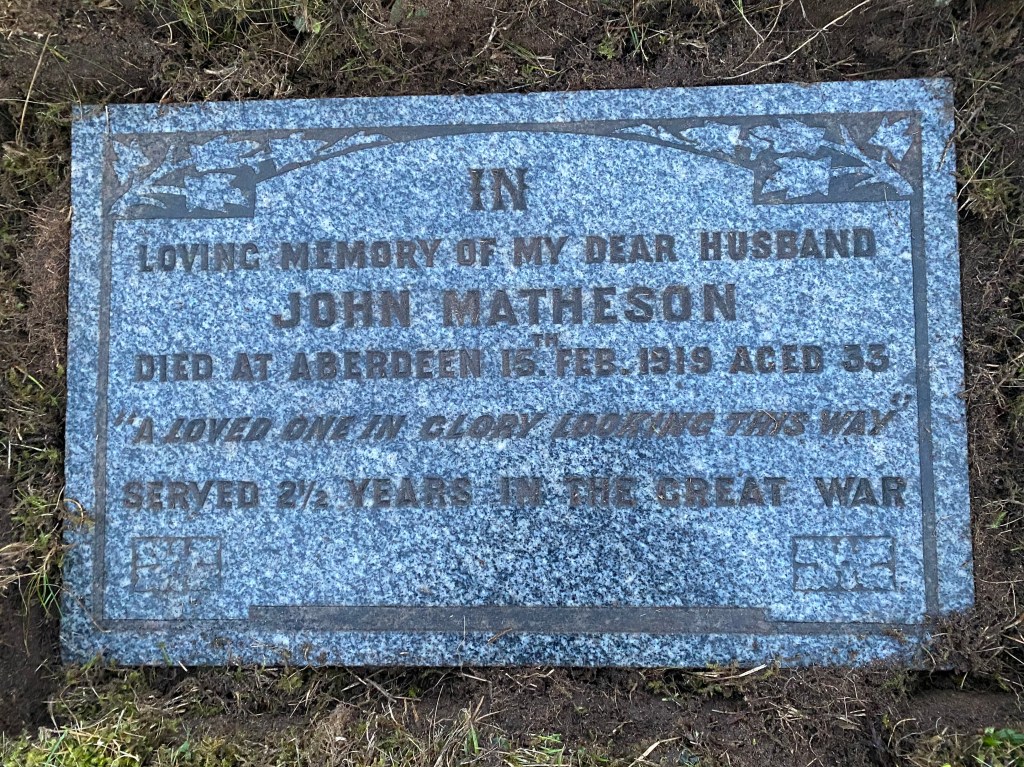
John Matheson died at Aberdeen Royal Infirmary from pneumonia, ‘from the effects of his wounds’, on 15th February 1919 and his funeral took place with military honours. He was buried in New Elgin Cemetery. However, no head stone was visible in April 2025. In February 2026, the headstone (pictured below) was discovered underneath several inches of soil and grass.
Following his death, the Daily Record, 19th February 1919, reported that John Matheson, ‘served in India with the forces before embarking on a professional career [in boxing]. Johnny had two great qualities that make for success in almost any walk of life.
“He was confidence personified, and he was downright game to the heels of him… He was a big-hearted, simple soul… but in the ring nobody could take a liberty with him… he could hit like a sledge-hammer.”
His widow, Florence, was the legatee of his pension and belongings. He died intestate and Florence was also granted the sum of £142 at Aberdeen on 31 March 1919.
John Matheson was one of six brothers who served in the First World War. None of the six brothers survived the war without injury. Charles, who had his right arm amputated. James, who had his left leg amputated. Roderick, who was killed at Frelinghein, in France. Thomas, who was wounded in the head, then contracted malaria. William, who suffered a head wound, then contracted neuritis.
Family
The following family information has been ascertained from several sources including the 1891, 1901, 1911 Census and his Pension Card.
His family is shown as follows :-
- Wife: Florence Malone or Matheson, born 1888.
- Son: Richard John Matheson, born 18 September 1911 at Saltcoat, Ayrshire.
- Daughter: Florence Jane, born 23 February 1913 at Manchester.
- Daughter: Lillian Beatrice, born 15 February 1915 at Chester. (d.1917)
- Father: Alexander Matheson, born c.1850 at St. Andrews, Morayshire. (Living Machine Agent)
- Mother: Jane Simpson or Matheson, born c.1856 at Elgin, Morayshire.
- Sister: Margaret, born c.1877 at Glasgow. (Net Factory Worker)
- Brother: Thomas, born c.1879 at St.Andrews, Elginshire.
- Brother: Alexander, born c.1882 at Elgin, Morayshire.
- Brother: William, born c.1884 at Elgin, Morayshire.
- Sister: Jeanie, born c.1888 at Elgin, Morayshire. (d.1890)
- Sister: Annie, born c.1890 at Elgin, Morayshire.
- Brother: James, born 11 September 1892 at Elgin, Morayshire.
- Brother: Roderick, born 4 April 1895 at Elgin, Morayshire.
His obituary in the newspaper states that he was the father of one child (Richard John Matheson) and his military pension card awarded money for two children under the age of 16 from 1920. I have been unable to ascertain the name of the second child if there is one.
Addresses
The following addresses have been ascertained for him which have been taken from the 1891, his sons Birth Certificate, Discharge, Probate Documents and the Childrens Register of Births.. :-
- 1891: 263 High Street Close, Elgin.
- 1911: 51 Windmill Street, Saltcoats, North Ayrshire.
- 1913: Longdon Road, Longsight, Manchester, Lancashire.
- 1915: 35 Shakespeare Road, Neston, Chester.
- 1916: 13 Crown Street, Aberdeen (intended address following discharge).
- 1919: 76 Great Western Road, Aberdeen.
When John Matheson died, in February 1919, he was living at 76 Great Western Road, in Aberdeen, with his wife Florence.
Medals
John Matheson was awarded the 1914-15 Star, Victory and the British War Medals for his service in the Great War. He was also awarded the Silver War Badge No.117515, following his injury.
Memorials
John Matheson is honoured and remembered on the following memorial.
Remarks
The death of his daughter Lillian Beatrice Matheson was registered in Birkenhead, Cheshire in the first quarter of 1917.
Links to Additional Information
- Find a Grave: John Matheson
- Lives of the First World War: John Matheson
Groups
- 1914-15 Star Awardees
- Died from Influenza or Pneumonia
- Morayshire Roll of Honour
- Silver War Badge Awardees
- Sportsmen and Women
Contributors:-
- Glen Wilson (Main Article)
- Rosemary Downie (Relative) Family Information.
References
- 1891 Census (Ancestry).
- Silver War Badge Records (Ancestry).
- Discharge paper (Ancestry).
- Medal Index Card (Ancestry).
- Pension Card (Western Front Association).
- Register of Soldier’s Effects (Ancestry).
- Medal Roll 1914-1915 Star (Ancestry).
- Medal Roll Seaforth Highlanders, British War and Victory Medals (Ancestry).
- Scotland National Probate Index 1919. (Ancestry).
- Bewsher, F.W, The History of the 51st (Highland) Division 1914-1918 (Edinburgh, 1921).
- Morayshire Roll of Honour.
- Silver War Badge Records (Ancestry).
- The Aberdeen Daily Journal, 1 April 1911 (British Newspaper Archive).
- The Aberdeen Daily Journal, 14 April 1911 (British Newspaper Archive).
- Daily Record, 19 February 1919 (British Newspaper Archive).
- Banffshire Advertiser dated 20 February 1919 (British Newspaper Archive).
- Evening News (Waterford) dated 27 December 1913 (British Newspaper Archive).
- Northern Scot and Moray and Nairn Express 11 July 1914 (British Newspaper Archive).
- Boxing (newspaper) dated 13 May 1911 (British Newspaper Archive).
- Wolverhampton Express and Star 19 November 1912 (British Newspaper Archive).
- Boxing (newspaper) dated 28 January 1911 (British Newspaper Archive).
- New Ross Standard dated 2 January 1914 (British Newspaper Archive).
- Birth Certificate: John Matheson (Scotlands People).
- Birth Certificate: Richard John Matheson (Scotlands People).
- Baptism Records: St Andrew, South Levenshulme, Manchester, 1913, page 92. (Florence Matheson (Ancestry).
- Baptism Records: St. Pauls, Seacombe, Cheshire, 1915, page 129. (Lillian Matheson)
- Register of Deaths, Birkenhead, Cheshire 1917. (Lillian Matheson)

