8th Battalion, Canadian Infantry, 26 September 1916
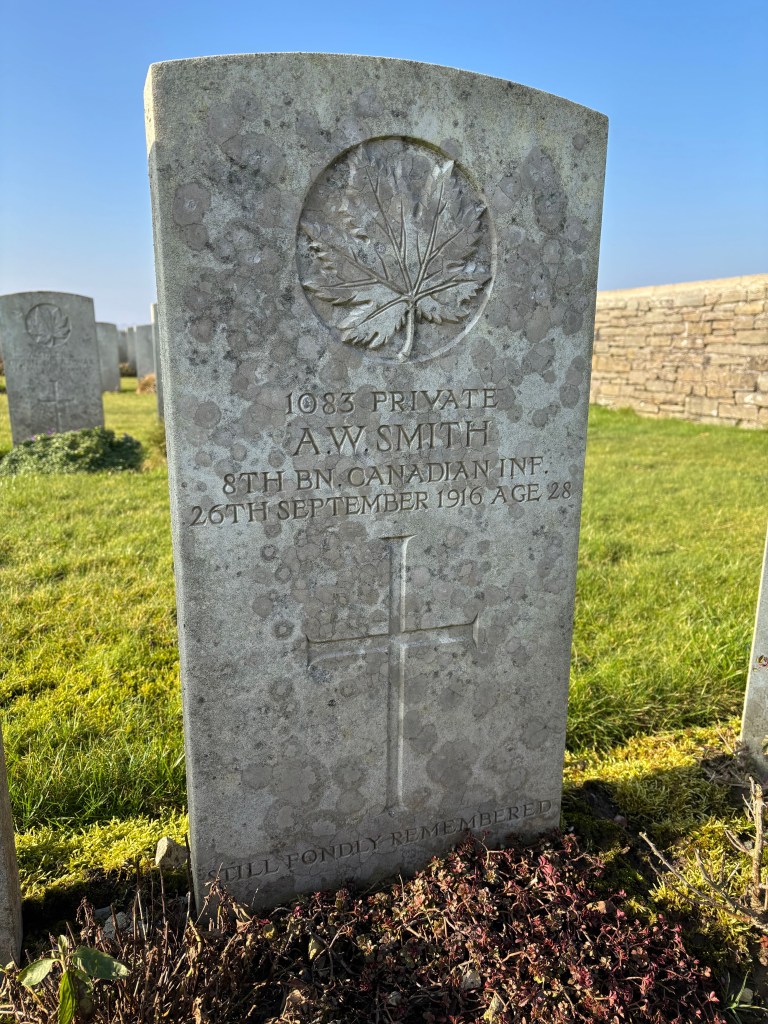
Synopsis of Life and Military Service
Alexander Wilson Smith was born on 30 April 1888 at Mortlach, Dufftown, Banffshire, Scotland to his parents Willian Smith and Isabella Gordon or Smith.
Little is known of his early life, however his father was a farmer, and later in life Alexander is shown as being a farmer and whisky distillery worker, so it can be reasonably assumed that he trained as a farmer on his fathers farm.
In 1909, Alexander is shown as making Rose Ann Blainey, a Domestic Servant pregnant. This may have been one of the deciding factors in Alexander seeking another life abroad, so, in 1910, Alexander, accompanied by his brother William, emigrated to Canada to find a better future in farming.
In 1913 at Banff Sheriff Court, Banffshire, Scotland, the aforementioned Rose Ann Blainey, pursued a Paternity case against him in his absence, in relation to the birth of his daughter on 10 May 1910. She won this case and was awarded a monetary payment. It is unknown if she actually received any payment however from Alexander. The name of the child was Isabella Mary Blainey.
On 22 September 1914, shortly after the outbreak of the war, Alexander enlisted at Valcartier, Quebec, Canada into the Canadian Infantry and was allocated to the 8th Battalion (Winnipeg Rifles). At the time, his marital status was given as single and his occupation shown as a Farmer. His address was given as 10841st-127th Street, Edmonton. During his medical he was described as:-
- Height: 5’9″
- Chest expansion 34″-36″
- Complexion: Fair
- Eyes: Blue
- Hair: Dark Brown
- Religion: Presbyterian
- Distinctive Marks: Scar below right groin, across base of thumb, fore finger left hand and scar middle of back.
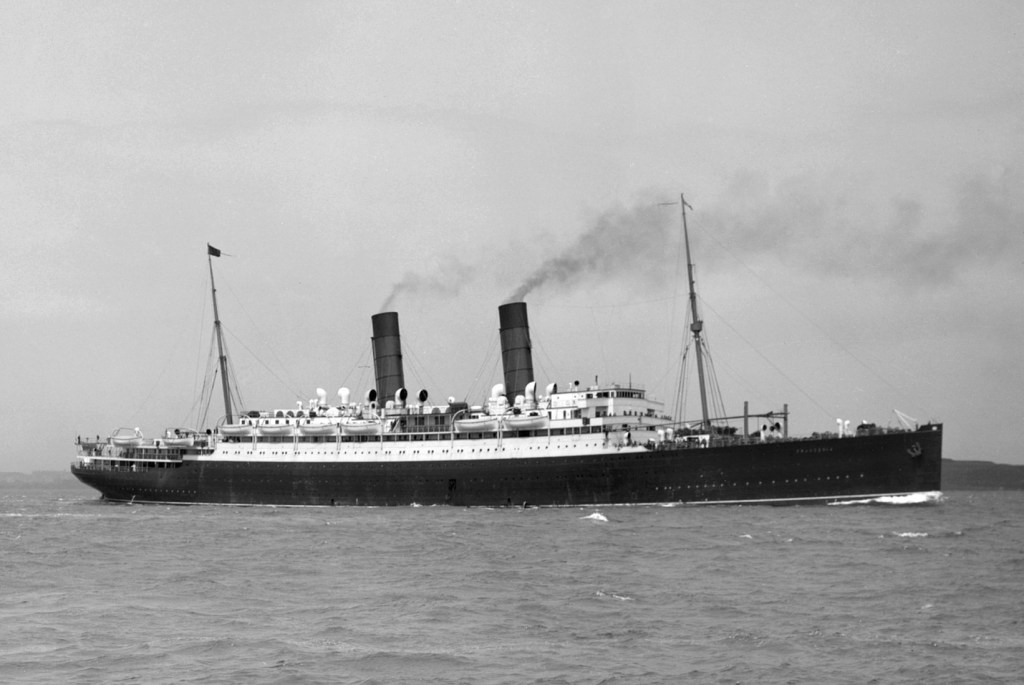
On 3 October 1914, along with his unit, he sailed for Europe on board the Royal Mail Ship Franconia and disembarked at England around 14 October 1914 where they undertook further training on Salisbury Plain, Wiltshire.
About 10 February 1915, his unit left Avonmouth, a suburb of Bristol and disembarked at France around the 13 February 1915. On their arrival, they engaged in further training which included trench work. On the 2 March 1915, the Battalion moved into the front line for the first time in front of the village of La Boutillerie, South-East of Fleurbaix, which at the time was in a relatively quiet sector.
On 10 March 1915, the Battalion was in the line during the Battle of Neuve Chapelle. Although the unit was not engaged in a direct attack, it remained in the trenches while engaging the enemy. It was here they experienced their first shelling and poisonous gas.
Around 20 December 1915, Alexander reported injured at No.8 Casualty Clearing Station at Bailleul, with a dislocated left thumb which he stated had occurred when he fell into a hole at Plug Street (Ploegsteert, Belgium), he also reported that he had a ‘Hammer Toe’ which had happened several months earlier when he was was stood on by a horse. This was still causing him extreme pain and as a result his 2nd toe on his left foot was amputated at No.2 Stationary Hospital at Boulogne.
He was then casualty evacuated to England and was a patient in various hospitals including at the Duchess of Connaught Red Cross Hospital, Taplow, Hillington House Convalescent Hospital, Uxbridge, Canadian Convalescent Hospital, Bearwood Park, Wokingham before being assessed at a medical board at the No.11 Canadian General Hospital, Moore Barracks, Shorncliffe, Kent. While there, on 20 May 1916, he went Absent Without Leave for three days, for which he was punished with 6 days Field Punishment No.2 and fined 6 days pay
He was discharged to his unit on 10 June 1916.
On 13 June 1916, his battalion was involved in The Battle of Mount Sorrel, Belgium which resulted in an allied victory, at the trenches and high ground around Hooge, Sanctuary Wood and Mont Sorrel. This was at a high price for the battalion however, with around 300 casualties.
The Battle of Thiepval Ridge
The Battle of Thiepval Ridge took place between the 26 and 29 September 1916 in the Somme Region of France and it was the Allies objective to take control of the high ground which the Germans occupied, which dominated the area between Thiepval and Courcelette. This was an extremely well defended section of the frontline and the plan was that the 1st Canadian Division were to capture a number of German trenches which included, the Zollern, Hessian and Regina trenches which were positioned along the ridge. They were also to capture the Kenora Trench, a spur of the Regina Trench.
The Germans were subjected to heavy and continuous bombardment for three days prior to the attack from more than 800 allied guns, which mainly concentrated on the enemy trench-line, in the meantime some of the German troops had been instructed to advance into some of the shell craters at the front of the forward trenches. This manoeuvre was to surprise the attacking Canadian forces. The attack was meant to be supported by British Mark 1 tanks but one was taken out by German artillery and the other broke down.
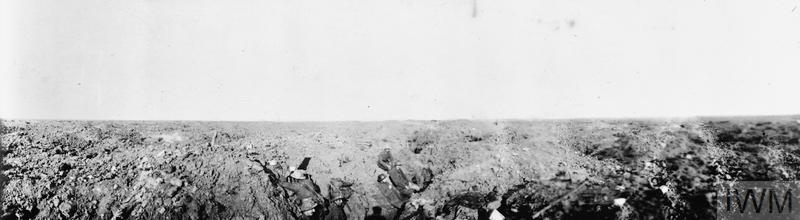
During the Canadian attack, the German artillery and machine gun fire inflicted heavy casualties on the attacking troops as the Canadian crossed open ground. By the end of the first day, few of the German trenches had been captured or fully occupied, however, under pressure from the attacking allied troops the Germans began withdrawing to the Regina trench on the night of the 26 into the 27 September 1916. It is likely that during this attack, Alexander Wilson would have been killed.
Fighting was to continue until 29th September 1916 as the Germans retired by which time the Canadian and British troops took control of the Zollern Trench and nearly all of the Hessian Trench. They were not able to capture either the Regina or Kenora trenches despite several costly attempts. This was to be the Canadian Corps’ next objective. The Canadians suffered around 3,500 killed, missing and injured during the battle for the ridge
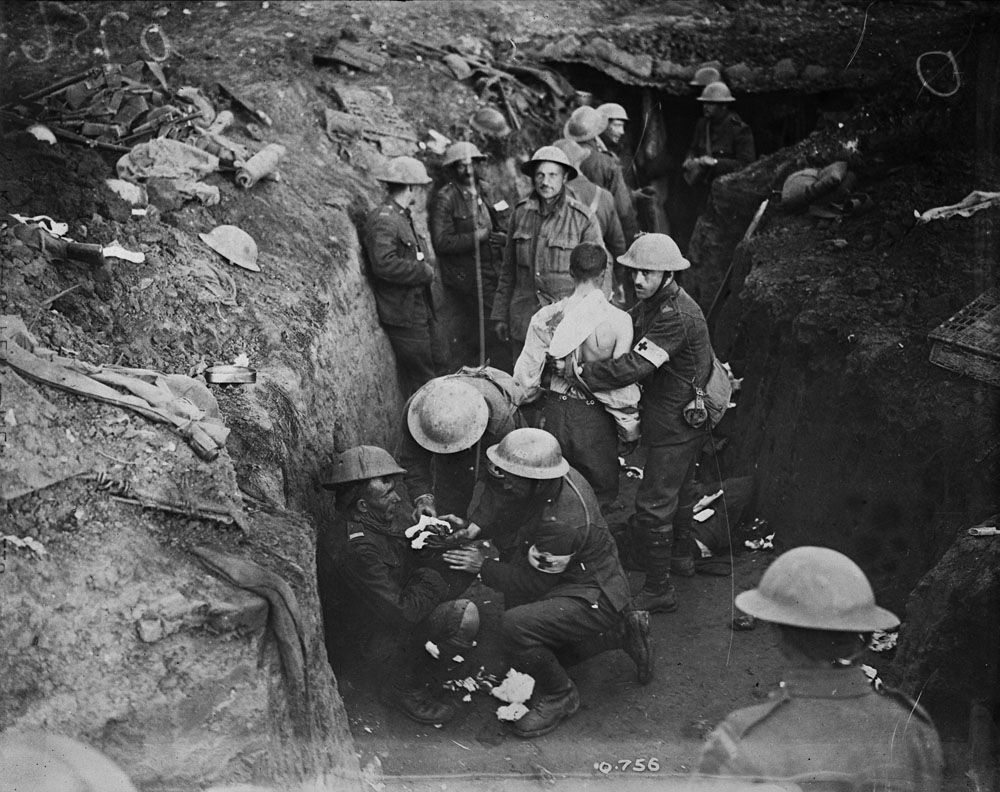
Alexander being one of those killed in action, he was buried near the place of his death, his body was later concentrated into Regina Trench Cemetery, Grandcourt, France along with many member of his former colleagues during 1919.
Aberdeen Press and Journal
Extract from the above publication dated 17 October 1916 :-
PRIVATE SMITH, BOTRIPHNIE
Information has been received by Mr Smith, farmer, Blackmuir, Botriphnie, of the death of his third son. Private A.W. Smith, Canadian Scottish, who was killed in action on 26th September. The deceased soldier emigrated to Canada in 1910, and was engaged in farming. He enlisted at the outbreak of the war.
War Diary – 8th Canadian Infantry
The War Diary of the 8th Canadian Infantry on the date of Alexanders death reads the following (those words marked as ‘?’ are currently unable to be transcribed.) :-
26 September 1916
1.30 a.m. – All troops reported in their jumping off positions.
9 a.m. – G.O.C. 2nd Brigade called and reviewed the situation with the C.O..
10.45 a.m. – Enemy 77 m.m. shell knocked out crew of a Section gun, no fatal wounds and gun undamaged.
12.35 a.m. – Our intense bombardment of enemy forward positions gradually lengthening out over and past the ZOLLERN TRENCH, first three waves of the attack went forward under cover of our barrage and occupied the first objective, with the exception of ‘B’ Company on our exposed flank. Major McLeod at once called for Artillery action on his left flank after which he was enabled to continue to his first objective owing to the intensity of the enemy’s retaliation, both artillery and machine gun, reports were infrequent and slow.
In the further advance to the 2nd objective “B” Company was assisted by the 2 Platoons of the 10th Battalion under Lieutenant Burbridge who were ordered to garrison the ZOLLERN TRENCH, (the enemy’s front line.)
Lieutenants Maund, Turner and O’Neill personally reports the lodgement in the HESSIAN TRENCH of themselves and 80 Other Ranks, remnant of ‘C’ and ‘D’ Companies. No further reports from ‘B’ Company. As yet no report at all from ‘A’ company. Wounded men from the two left companies i.e. ‘A’ and ‘B’ report that they reached the final objective but had to ????? to the 2nd HESSIAN TRENCH – on account of the failings of the Battalion on their left , penetrating further than their first objective.
The situation on the left resulted in conflicting reports being sent into Battalion Headquarters from subsequent observations it appeared that ??? successful in the taking of the ZOLLERN REDOUBT the attack of the 11th Division was held up in front of the STUFF REDOUBT, which was in a commanding position immediately adjoining our LEFT BOUNDARY. The firing from the Machine Gun in this Redoubt caused severe casualties to our ‘B’ and ‘A’ Companies who formed the left flank of our attack.
5 p.m. – Lieutenant Maund reported personally to the C.O. that himself, 2 officers and about 60 Other Ranks of ‘C’ and ‘D’ Companies had reached and occupied the final objective the REGINA TRENCH and had built block to the west. Later an officers patrol under Lieutenant Levy of the 7th Battalion reconnoitred the position to the west of this block and found no signs of the enemy.
One enemy machine gun was captured by Lieutenant Turner who immediately reversed it and used it against the Huns, also in the ZOLLERN TRENCH we captured two enemy machine guns which were in ????? used against the enemy.
A Company of the 7th Battalion moved up to the HESSIAN TRENCH as reinforcements and were later ordered to establish posts diagonally from point 97 in HESSIAN to point 36 in ZOLLERN thus protecting the weak position of the left flank. Total number of unwounded prisoners captured amounted to 160 all ranks, most of whom very readily surrendered. Weather continues fine.
Family
Alexander Wilson was born on 30 April 1888 at Mortlach, Dufftown, Banffshire. The following family information is taken from the 1891 Census, and the Scottish National Probate Index.
His family is shown as follows :-
- Daughter: Isabella Mary Blainey or Hadden, born 10 May 1910 at Glasgow. (d.19 Feb. 1999 at Buckie, Moray).
- Father: William Smith, born c.1855 at Mortlach, Banffshire – Farmer. Died 22 May 1925.
- Mother: Isabella Gordon or Smith, born c.1867 at Gabriel, Banffshire – Crofters Wife. Died 19 March 1943.
- Sister: Jessie, born c.1879 at Aberlour, Banffshire.
- Brother: James, born c.1881 at Aberlour, Banffshire.
- Sister: Isabella, born c.1883 at Glenlivet, Banffshire.
- Brother: William, born c.1884 at Glenlivet, Banffshire.
- Brother: Robert, born c.1886 at Mortlach, Dufftown, Banffshire.
- Brother: Frank, born c.1890 at Mortlach, Dufftown, Banffshire.
Paternity Case
Banff Sheriff Court
Register of Extracted Decrees
(National Records of Scotland reference: SC2/8/18 p. 378)
[At Banff, the] Thirteenth [day of] March [Nineteen Hundred and] Thirteen [in an action in the Sheriff Court of the Sheriffdom of Aberdeen, Kincardine, and Banff, at Banff, at the instance of] Poor Rose Ann Blainey, Domestic Servant, c/o Peter Stewart, The Fold (Whitefold), Tomnavoulin, in the Parish of Inveravon and County of Banff Pursuer Against Alexander Smith, Distillery Worker, c/o William Smith, Farmer, Blackmuir in the Parish of Botriphnie and County of Banff Defender, [the Sheriff] in absence [Decerned the Defender to pay to the Pursuer the sums aftermentioned, in respect he was the father of an illegitimate] female [child of which the Pursuer was delivered at] Western District Hospital, Glasgow [on the] Tenth [day of] May 1910 [viz: Two pounds Sterling for inlying charges, and Five pounds Sterling [for] ten [years, payable said aliment quarterly in advance, with interest on the said inlying charges and on said aliment from the respective dates of payment], And Three pounds fourteen shillings and eleven pence Sterling of Expenses [Extracted at Banff this] Twenty Seventh [day of] March [Nineteen Hundred and] Thirteen [by me, Sheriff-Clerk Depute of Banffshire.]
Addresses
The following addresses have been ascertained for Alexander Smith :-
- 1891: Milton of Auchindoun, near Dufftown, Banffshire.
- 1910: Blackmuir (Farm), Botriphnie, Drummuir, Banffshire.
- 1914: 10841st-127th Street, Edmonton, Canada.
- 1916: Tomnoan Farm, Dufftown, Banffshire. (Parental Address)
Medals
Alexander Smith was awarded the 1914-15 Star, Victory and the British War Medals for his service in the Great War.
Memorials
Alexander Smith is honoured and remembered on the following memorials :-
Remarks
Although Alexander is shown as having the middle name of Wilson, he does not appear to have been christened with any middle name.
The mother of his daughter went on to have a further 9 children. The descendants of his daughter have been traced who were unaware of Alexanders name and have been presented with this information.
The Peter Stewart mentioned in the Paternity Case with whom Rose Ann was resident was her fostered father. His house in the case is stated as The Folds, this is in fact Whitefolds, a farm to the west of Tomnavoulin, Glenlivet, Banffshire.
Alexander received Field Punishment number 2 for being absent. This punishment entailed the person being restrained for a maximum of 2 hours per day for 3 out of 4 days up to a maximum of 21 days. Alexander however was awarded 6 days punishment.
Links to Additional Information
- Commonwealth War Graves Commission: A.W. Smith.
- Find a Grave website: Alexander Smith.
- A Street Near You website: Alexander Smith.
- Lives of the First World War: Alexander Smith.
- Canadian Service Record: Alexander Wilson Smith
- 8th Canadian Infantry in the Great War website.
- 8th Battalion Canadian Infantry War Diary
References
- Canadian Service Records.
- Aberdeen Press and Journal dated 17 October 1916.
- Commonwealth War Graves Commission.
- Banff Sheriff Court Entry (1913) Blainey v Smith (Scottish Indexes).
- Scottish National Probate Index: Father William Smith
- Census 1891
- 8th Battalion Canadian Infantry War Diary.
Groups
Contributors:-
- Vincent Stuart. (Main Article)
- Julie Swan. (Blainey Family Information)
- Kristen Den Hartog. (Alexander Smith immigration to Canada)
- Poppy Mercier (Photo of Grave).
 WW1 LIVES