H.M.S. Dublin, 31 May 1916
Synopsis of life
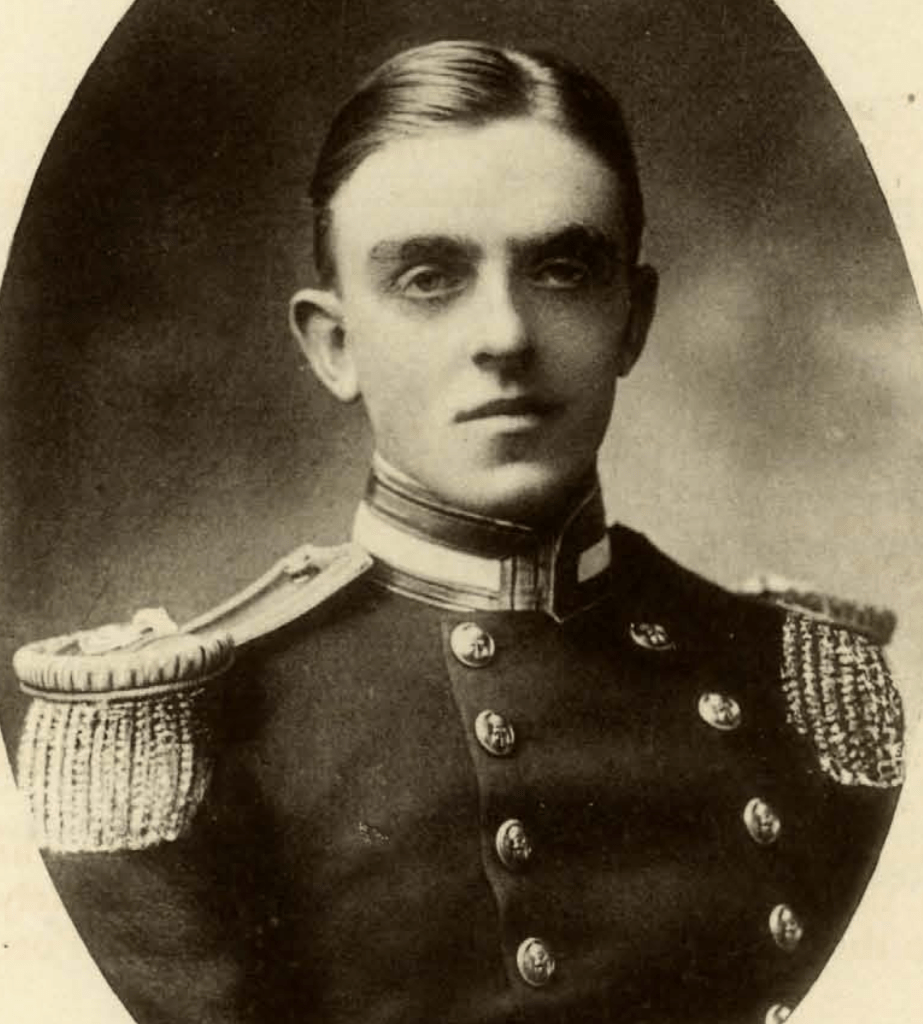
Percy Strickland was born on 4 July, 1890 at Kilburn, London, his baptism being recorded at St Marys Church, Kilburn, he was the third son of Frank and Alice Strickland, Highlands, Purley Downs, Surrey who was formerly of Kenilworth, Cape Town, South Africa.
Percy spent his early years and education in South Africa before attending Oundle School, Northamptonshire in September 1900 and was allocated to the ‘Sidney’ which was a boarding house and part of the school. He left the school in December 1905, passing into the Britannia Royal Naval College at Dartmouth. He then went onto a navigation course as a speciality at Greenwich College.
He was promoted to Acting Sub-lieutenant on 8 April 1909.
He was promoted to Sub-lieutenant on 15 December 1909.
He was promoted to lieutenant on 15 March 1911.
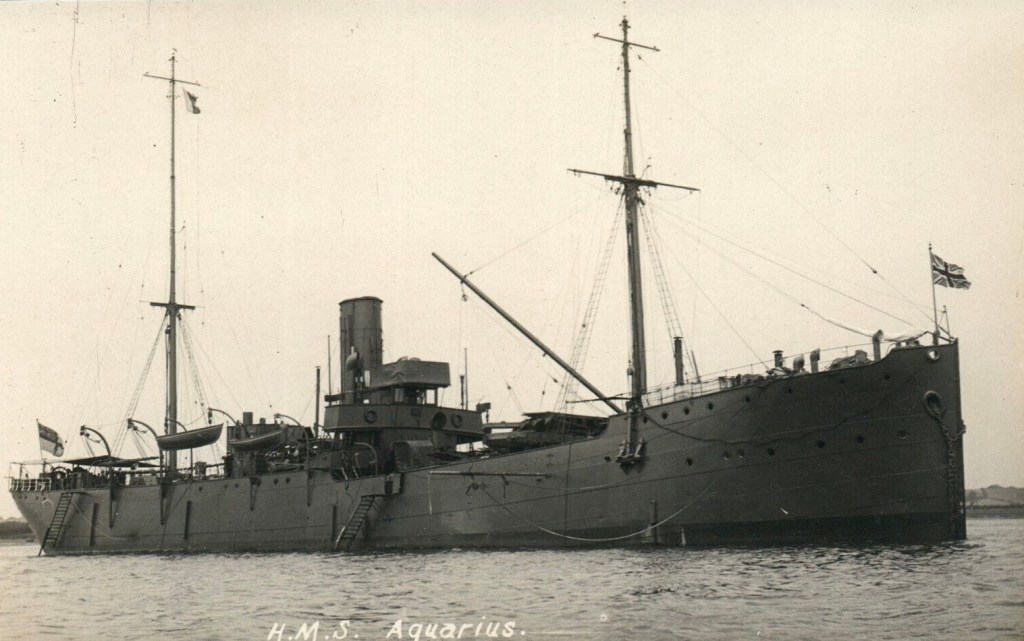
On 1 July 1913 he joined H.M.S.Aquarius which was adapted into a depot ship. Depot ships, were utilised during missions by providing support to smaller vessels which had been on patrol by replenishing stores and fresh water, medical services and minor repairs to a flotilla.
Wedding
On 10 December 1913, Percy, at that time still serving on H.M.S. Aquarius, married Miss Gwendolen Mary Brodie-Innes of Milton Brodie, Forres, the only daughter of her mother and father Mr. John William Brodie-Innes. The ceremony took place at St. John’s Episcopal Church, Forres, performed by the Reverend Walter Jenks of Aberlour and assisted by the Reverend Stair Douglas, Forres. The very young bridesmaids were Miss Macpherson Grant of Drumduan; Miss Galloway of Blervie; Miss Grant Peterkin of Grange; and Miss Marshall with Master James Grant Peterkin as page. Lieutenant Courtenay, of the Royal Naval Flying School, was groomsman.
He was due to be appointed to Admiral Jellicoe’s yacht the Sappho in August 1914, but this was cancelled on the outbreak of the Great War on 4 August, where he continued to serve aboard H.M.S. Aquarius, serving with a destroyer flotilla in the Dardanelles for about nine months, receiving his last commission on 15 March of 1916 when he was appointed to H.M.S. Dublin on 22 March 1916.
In Action and Death
On 31 May 1916, Percy was onboard H.M.S. Dublin and part of the 2nd Light Cruiser Squadron, commanded by Commodore William Goodenough, which included H.M.S. Southampton as the flagship, H.M.S. Birmingham and H.M.S. Nottingham. Their role being reconnaissance and protecting the destroyers from attack. H.M.S. Southampton, as part of the squadron had been the first ship to sight the German Grand Fleet earlier in the day and had come under fire but had not sustained any serious damage before breaking off the contact. Percy Strickland had been slightly wounded in the neck in the afternoon action while aboard H.M.S. Dublin. About 2220 hours that night the 2nd Light Cruiser Squadron, heading in a southerly direction to the east of the British 11th Destroyer Flotilla, had seen the 11th Flotilla in action earlier in the day so was aware that the enemy may be in the vicinity. About this time, a Lieutenant aboard H.M.S. Southampton saw a line of mystery ships sailing towards them on a merging course, the mystery ships although unidentified at the time turned out to be the IV Scouting Group of the German High Seas Fleet consisting of the light cruisers, Stettin, Munchen, Frauenlob, Stuttgart and Hamburg.
In the dark, neither the Germans nor the British were able to suitably identify the other vessels as enemy, although both brought their ships into a state of reddiness. About 2235 hours as the two lines of ships closely converged at about 800 yards, each group challenging the other with their respective identification lights, a shot rang out from H.M.S. Dublin which hit an enemy ship just above the waterline, each flotilla then switched on their searchlights and opened fire. Due to the close proximity of the ships each strike did incredible damage, the shots often passing through either side of the vessels, the germans mainly focused their fire on the lead ship, H.M.S. Southampton, along with Dublin to a lesser extent , H.M.S. Dublin with Birmingham and Nottingham were astern and escaped the majority of enemy fore. The Southampton sustained severe damage to both the ship and crew, most of the gun turrets being put out of action, however it was able to fire off a torpedo which fatally struck the Frauenlob, which was to sink a short time later taking over 320 of her crew with her with only 5 surviving. In these exchanges between the two lines of vessels while onboard H.M.S.Dublin, Percy Stickland was asked to go below to the chart room. While there, an enemy shell passed through from corner to corner, passing out without exploding, but a splinter caught him in the neck, severing the carotid artery. He was able to walk back on deck to see the doctor, but succumbed to effects of haemorrhage about midnight of 31 May 1916. Along with Strickland a further two signalmen were killed and 22 rating wounded on H.M.S. Dublin.
Albert Scott, his ship Captain said that “He was dreadfully sad at losing my Navigating Officer who was killed when standing close beside me. He was a splendid fellow and I miss him very much. He was married and they were a most devoted couple.”

Funeral: 14 June 1916
The remains of Percy Strickland were conveyed from the south to Forres on 12 June 1916, and then to Kinloss Abbey on the 13th where it was placed in the private chapel. The funeral on the Wednesday was of a private nature and the service was conducted in the chapel by the Reverend Canon Hay-Dinwoody of Elgin. The coffin was wrapped in the Union flag, and a beautiful wreath of white carnations was sent by his widow which was buried along with the coffin.
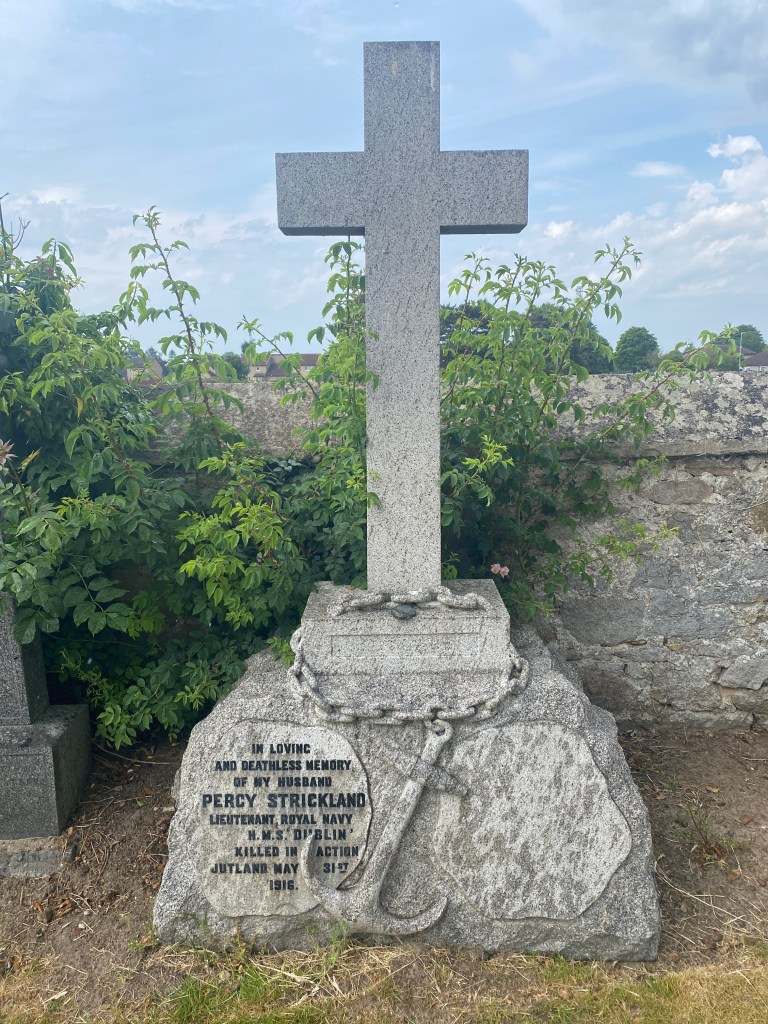
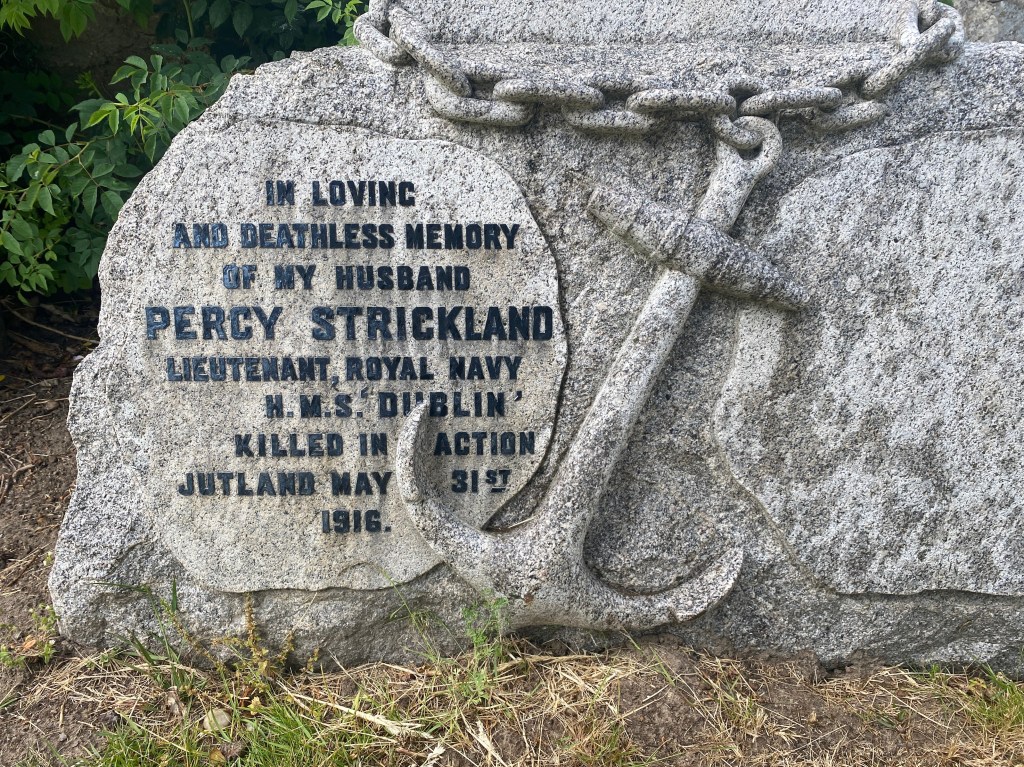
His wife Gwendolen was awarded £113 from Percy’s Will.
Further Information
Prior to the War, Percy Strickland had been a member of numerous ships, these included H.M.S. Beagle and H.M.S. Lion.
Following his death, his wife Gwendolen joined the Women’s Royal Naval Service at Rosyth in September 1917. She served within the United Kingdom.
His father-in-law John William Brodie-Innes, was a local land owning Laird who had published numerous books on local folklore.
Family
Percy Strickland was born on 4 July 1890 at Kilburn, London to Frank and Alice Strickland.
His family is shown as follows :-
- Wife: Gwendolen Mary Brodie-Innes or Strickland, born 23 January 1885 at London.
- Daughter: Leslie Alice Strickland, born 1915 at Forres, Morayshire.
- Father: Frank Strickland. (Dental Surgeon)
- Mother: Alice Esse or Strickland, born c.1849 at Kentish Town, London.
- Brother: Cyril, born c.1882 at Port Elizabeth, South Africa.
- Brother: Dr Harold F., born c 1883 at St. Johns Wood, London.
- Sister: Dora Catherine, born c.1884 at St. Johns Wood, London.
- Sister: Alice M., born c.1884 at Port Elizabeth, South Africa.
Following the death of Percy, his wife Gwendolen and daughter Leslie Alice went by the surname of Brodie-Strickland.
Gwendolen never re-married and died in Spain in 1960.
Leslie Alice died in Ibiza, Spain in 1965.
Addresses
The following addresses have been ascertained for Percy Strickland:-
- 1890: Port Elizabeth, South Africa.
- 1891: 13 Powderham Terrace, Teignmouth, Devon.
- 1901: Oundle School, Northamptonshire.
- 1916: Balesmead, West Porlock, Somerset.
Medals
Percy Strickland was awarded the 1914-15 Star, the Victory and the British War Medals for his service in the Great War, these medals were issued to his widowed wife.
Memorials
Percy Strickland is honoured and remembered on the following memorials :-
- Oundle School Chapel, Oundle, Northamptonshire.
- Coulsdon and Purley War Memorial, Woodcote, Croyden, Greater London.
- All Saints Church, Sanderstead, Croydon, Greater London.
Remarks
The Battle of Jutland occurred between the 31 May and 1 June 1916. Although generally seen as a deadlock, the German Navy could not sustain the losses incurred to their fleet in comparison to those of the British Fleet.
On some documents he is shown as having died at sea and other documents have him as having died at the Royal Naval Hospital, Queensferry. I believe he died at sea and was then taken to Queensferry, as the most important documents show him as being killed in action at sea.
The two other sailors killed onboard H.M.S. Dublin in the same action were Leading Seaman Frank Crowhurst and Signaller Reginald Fenmore, both are buried at South Queensferry Cemetery, West Lothian, Scotland.

Links to Additional Information
- Commonwealth War Graves Commission: Percy Strickland.
- Find a Grave website: Percy Strickland.
- A Street Near You website: Percy Strickland.
- Lives of the First World War: Percy Strickland.
References
- Royal Navy Medal Roll.
- Morayshire Roll of Honour.
- 1891 Census.
- 1901 Census.
- Commonwealth War Graves Commission.
- Pension Card.
- U.K. Navy Lists (Various Dates).
- The Nairnshire Telegraph (13 June 1916, page 4).
- The Dundee Courier (11 December 1913, page 4).
- The Daily News (London) (12 December 1913, page 3)
- Beckenham Journal (10 June 1916, Page 4 Column 4)
- Baptism Records, St Mary’s Church, Kilburn London 180 page 173.
- Book: Jutland 1916 – Death in the Grey Wastes by Nigel Steel and Peter Hart.
Groups
Contributors:-
- Vincent Stuart.
- Lesley (Family History Researcher) (Family Information)
 WW1 LIVES