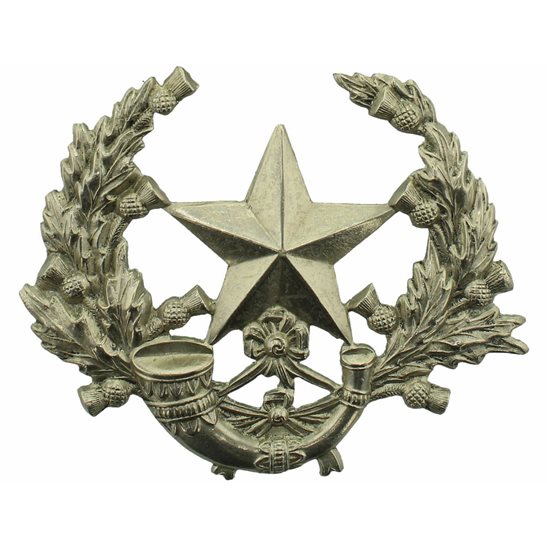
10th Battalion, Cameronians (Scottish Rifles), 15 September 1916
Synopsis of Life and Military Service
Harold “Jack” Albert Arden Spring was born on 4 April 1897, the son of William Albert Spring, a bank manager, and his wife Jessie. Although born in London and baptised at Stockwell, he grew up within a family whose professional life was closely connected to the Union of London & Smiths Bank, a connection Harold himself would continue as a young man. His earlier years were spent at Bristol and he attended the Grammar School there from 1908 to 1910. By the time he reached working age, he was employed at the bank’s Nottingham branch, and it was from here, nearing the end of his teens, that he made the decision to enlist for service during the First World War.
In early 1915, Spring joined the 8th Battalion, King’s Royal Rifle Corps, one of the British Army’s renowned light infantry regiments. His abilities were evidently recognised swiftly, for within only a few days he was promoted to the rank of Lance-Corporal. After several months of intensive training, he was sent to France on 21 July 1915, joining the fighting near Hooge, a sector east of Ypres that had seen some of the most violent and chaotic actions of the war.
The young soldier’s introduction to the front was abrupt and perilous. At the moment of his arrival, German forces were, as contemporary reporting put it, “pressing hard” to break the British line and push towards the Channel ports. For a new recruit, Hooge offered no gentle acclimatisation. Spring very quickly faced the full danger of trench warfare. On one occasion, the sight of his rifle was shot away; on another, the entire rifle was blasted from his hands, the same shot killing the comrade who stood beside him. A third incident buried him inside a dug-out. Remarkably, he survived each incident without serious injury, an escape that impressed both his comrades and his community at home.
News of his conduct and survival reached Hucknall, where the local newspaper recorded not only his near-misses but also the pride felt within the town. Shortly afterwards, Spring received word that he had been granted a commission in the 12th Reserve Battalion of the Scottish Rifles (Cameronians), a notable honour for someone of his youth and experience. He returned briefly to Hucknall in August 1915 to assume his new status as Second Lieutenant, receiving warm congratulations and well-wishes from local residents before departing for further training in Roxburgh, Scotland.
By 1916, Spring had returned to France, now serving with the 10th Battalion, Cameronians (Scottish Rifles), taking part in the vast and demanding operations of the Somme. The battalion was heavily engaged during the Battle of Flers-Courcelette, the phase of the Somme offensive that began on 15 September 1916, coinciding with the first use of tanks in warfare. In the confusion and intensity of the fighting, Spring was initially reported “wounded and missing,” a phrase that left his family in painful uncertainty for many months.
It was not until April 1917 that Harold’s parents, William and Jessie Spring, finally received official confirmation that their son had been killed in action on 15 September 1916. He was nineteen years old.
Harold Albert Arden Spring’s body was never formally identified, and he has no known grave. Instead, his name is inscribed on the Thiepval Memorial to the Missing of the Somme, the towering monument that commemorates more than 72,000 British and Commonwealth soldiers who vanished on the Somme battlefields with no resting place that could be recovered.
From his early employment at a Nottingham bank to his rapid rise from private soldier to commissioned officer; from his extraordinary escapes at Hooge to his final sacrifice on the Somme, Spring’s short life reflects the experiences of a generation of young men who answered the call to serve and never returned. His story lives on in local memory, in wartime records, and on the stones of Thiepval, which stand as testimony to his courage and to the immense human cost of the First World War.
Following his death, according to the Pension Card and the Register of Soldiers Effects, his mother Jessie was the Sole Legate of his property and pension.
War Diary – 10th Cameronians (Scottish Rifles)
The war diary for the 10th Cameronians on the date of his death states the following:-
15 September 1916
At 10 p.m. 14th / 15th the Battalion moved into its jumping off trenches. Everything working smoothly and well ahead of time. Dressing station finished, good breakfast ready for cooking and cooking places previously arranged. Telephone arrangements completed.
At 6.20 a.m. the Battalion advanced for the assault – The advance was made in waves – there was no hurry. The first objective was reached at 6.35 a.m. Some of the men had lost direction owing to the smoke of the barrage and got too far to the left. Between 6.35 a.m. and 6.45 a.m. these men were collected and brought back ready for the barrage lifting at 6.45a.m. On its lifting the battalion moved forward to its final objective in MARTINPUICH, which it successfully occupied and started digging in. A strong point was at once started in front of this.
The enemy had offered no resistance to speak of, few machine guns had opened fire, the enemy had been surprised and surrendered freely. A very large number of prisoners had been captured and several machine guns taken.
At 6.50 a.m. we had established a telephone station in the village of MARTINPUICH and from now on until relieved, communications by phone was maintained between Brigade and Martinpuich.
By 8am a 6ft trench had been dug and strong post completed. ???????? was then proceded with under direction of 91st Field Company Royal Engineers.
At 9.20 am patrols were sent out to clear the village. This they did taking a large number of prisoners including several officers. By 10.30 am, MARTINPUICH on left of the main road was clear of the enemy and we moved freely to its N.E. end without any opposition. The enemy on our front had retired to the ridge about 600 yards out of MARTINPUICH.
About 10 am the enemy artillery opened on MARTTINPUICH and continued pretty heavily. Up till now his barrage had been weak. From now onwards the enemy barraged heavily the entrance at the sunken road to MARTINPUICH.
At 4 pm we moved into PUSH ALLEY on the left of MARTINPUICH and forward of GUNPIT TRENCH. We met with no opposition and consolidated our position here, constructing another strong post in the centre of the village. Enemy shelling continued and there was a little hostile sniping. At 10.30 pm we were relieved by 9th Yorks. and Lancs. and returned to our new front line. The enemy moral was bad. We had extremely few casualties until we entered Martinpuich, thereafter we suffered heavily from shell fire.
An appendix showing orders issued, reports sent to Brigade and reports on the attack by Lt Roberts, 2/Lt Adam and CSM Bayenden is being prepared and will be forwarded later.
We had the following officer casualties, all wounded, Captain H.H. McGREGOR, Lieutenant W. GULLOCH, 2nd Lieutenants R. CALDWELL, I.S. TORRANCE, A.W. BUTTAR, H.A.A. SPRING, D.A. SEATH, J.H.D. LAWRIE, A.K. CAMPBELL, and Captain C.C. SCOTT. In addition to these, 2nd Lieutenants G. McC. FERGUSON, H.M. BRICKMAN and W. MYLES of the 46th Trench Mortar Battery, were wounded.
Notts. Local News
Extract from the above publication dated 21 August 1915 :-
Another Honour For Hucknall
A further honour has just been bestowed upon Hucknall in the appointment of one of its soldiers to a second-lieutenancy, namely, H. A. A. Spring, the son of Mr. W. A. Spring, the manager of the Union of London and Smiths Bank. Limited. “He enlisted first in the King’s Royal Rifles, and in the course of a few days he was raised to the rank of Lance-Corporal. After a few months’ training he went out to France in the middle of July, and was sent to take part in the defence of the British lines at Hooge, arriving at the time when the Germans, in football parlance, were “pressing hard” to break through to their goal (Calais). “This was no light experience for a soldier fresh into the country, but it is very satisfactory to state that young Spring came out of the ordeal without a scratch. He had some narrow escapes, nevertheless. On one occasion the sight of his rifle was taken off; on the second attempt that instrument of warfare was shot out of his hands a comrade on his left was killed; whilst on the third occasion he was buried in a dug-out. “Then he received the news that he had obtained a commission in the 12th Reserve Battalion of the Scottish Rifles (Cameronians), and was allowed to come home. He duly arrived at Hucknall last Thursday morning, and today he leaves for Roxburgh (Scotland) to take up his new appointment, accompanied with the best wishes of his many friends, who have congratulated him upon surviving such a hot baptism of fire as he encountered at Hooge.
Extract from the above publication dated 21 April 1917 :-
Mr. and Mrs. Spring have now received information, officially, that their son, Second Lieutenant Harold A. Arden Spring (Jack), 10th Scottish Rifles (Cameronians), who was previously reported “wounded and missing”, is now reported to have been killed in action on September 15, 1916.
Family
Harold Spring was born on 4 April 1897 at Stockwell, London. The following family information is taken from the 1901 and 1911 Census, and baptism Records.
His family is shown as follows :-
- Father: William Spring, born c.1861 at Winchester.
- Mother: Jessie Adelina Arden or Spring, born 22 July 1867 at Brixton.
- Brother: Cecil James, born c.1900 at Fishponds, Gloucestershire.
Addresses
The following addresses have been ascertained for Harold Spring :-
- 1897: 118 Stockwell Road, London.
- 1901: 4 Devon Road, Bristol.
- 1911: 2 Elm Villas, Station Road, Shirehampton, Bristol.
Medals
Harold Spring was awarded the 1914-15 Star, the Victory and the British War Medals for his service in the Great War.
Memorials
Harold Spring is honoured and remembered on the following memorials :-
- Hucknall War Memorial, Titchfield Park, Nottinghamshire.
- St Mary’s Magdalene Church Memorial Plaque, Hucknall, Nottinghamshire.
- St Mary’s Magdalene Church Chapel Memorial, Hucknall, Nottinghamshire.
- The Scottish National War Memorial, Edinburgh Castle.
- Book – Roll of Honour of Cameronians (Scottish Rifles).
Remarks
Following the end of the war and the issuing of medals, his mother’s address was shown as the following. It is unknown whether Harold would have resided there:-
- 43 Tisbury Road, Hove, Sussex.
Links to Additional Information
- Commonwealth War Graves Commission: Harold Spring.
- Find a Grave website: Harold Spring.
- A Street Near You website: Harold Spring.
- Lives of the First World War: Harold Spring.
References
- Commonwealth War Graves Commission.
- Notts. Local News dated 21 August 1915, page 3, Col. 6.
- Notts. Local News dated 21 April 1917, page 6, Col. 5.
- 1901 Census (Ancestry).
- 1911 Census (Ancestry).
- Medal Index Card (Ancestry).
- Imperial War Museum Memorials website.
- Soldiers Died in the Great War (Ancestry).
- Baptism Records for Lambeth, London (This included the D.O.B.) (Ancestry).
- Register of Soldiers Effects (Ancestry).
- Pension Card (Fold 3).
- Medal Roll: British War And Victory Medals: Kings Royal Rifle Corps. (Ancestry).
Groups
Contributors:-
- Vincent Stuart.
 WW1 LIVES