Royal Navy, H.M.Submarine E.13,
19th August 1915
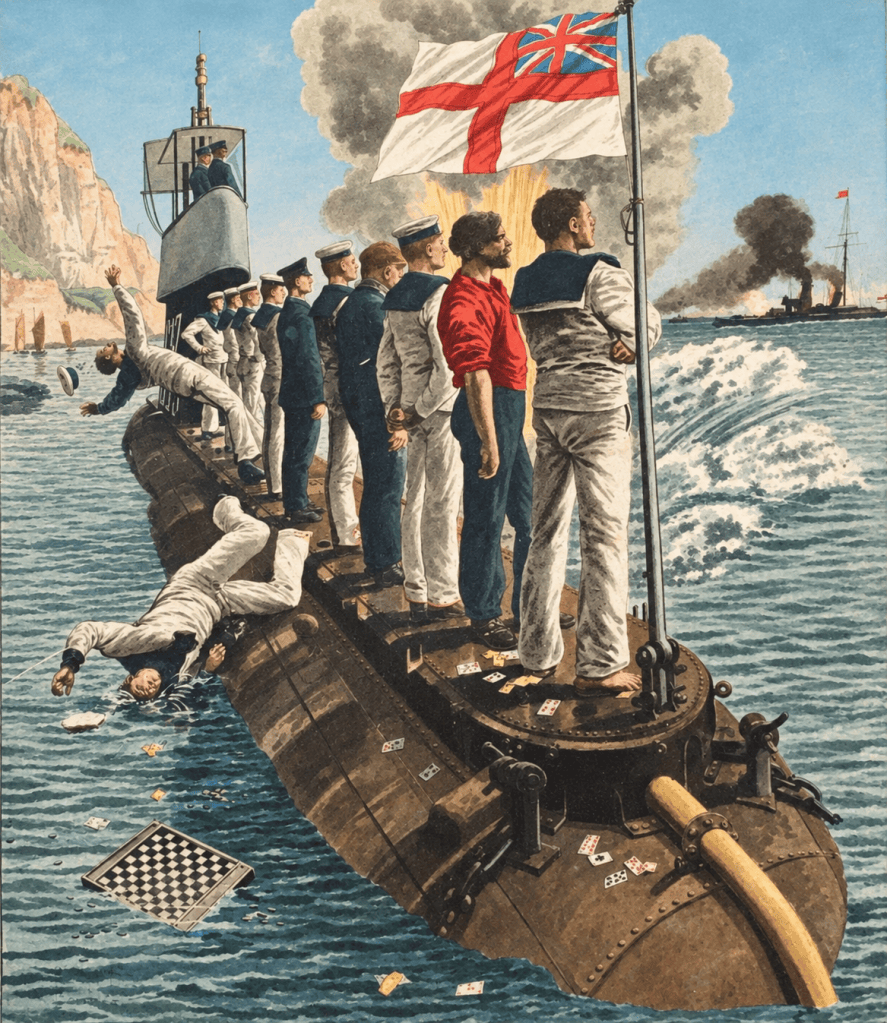
Originally published in Le Petit Journal, 12 September 1915.
Synopsis of Life and Military Service
The Missing Sailor from E.13
On 27 August 1915, the Derry Standard carried a short but remarkable report under the headline “Victim of E13 Outrage – Picked Up by German Torpedo Boat.”
The report stated that a German torpedo boat had recovered the body of the last missing sailor from the British submarine E13. His body was subsequently transferred to the Danish torpedo boat Narhvalen and taken to Copenhagen.
The missing sailor was Leading Seaman Henry Thomas Pedder.
His recovery was the final chapter in one of the more extraordinary incidents involving a British submarine during the First World War, an attack which took place not during a battle at sea, but against a stranded and virtually helpless submarine in neutral Danish waters.
Thomas Pedder
Henry Thomas Pedder was born at Crawley, Sussex, on 15 April 1888, the son of Henry Pedder, a farmer, and his wife Amelia.
He entered the Royal Navy as a young man and was given the service number 227585. Before joining the Navy he had worked as a milk boy. His naval record described him as
- Height: 5 feet 8 inches tall.
- Hair: Brown.
- Eyes: Brown.
- Complexion: Fresh.
By the outbreak of the First World War, Pedder was an experienced professional sailor who had already accumulated more than a decade of naval service.
His career began aboard HMS St Vincent on 31 August 1903. He subsequently served in a succession of ships and naval establishments including HMS Boscawen, HMS Latona, HMS Victory, HMS Hampshire, HMS Vernon, HMS Cochrane, HMS Mercury, HMS Arrogant and HMS Dolphin.
Pedder’s association with HMS Dolphin, the Royal Navy’s submarine depot ship at Gosport, began on 31 August 1912. From 4 December 1914 he was borne on the books of HMS Maidstone, another submarine depot ship. Although these depot ships and shore establishments appear on his official service record, his final operational vessel was the submarine E13.
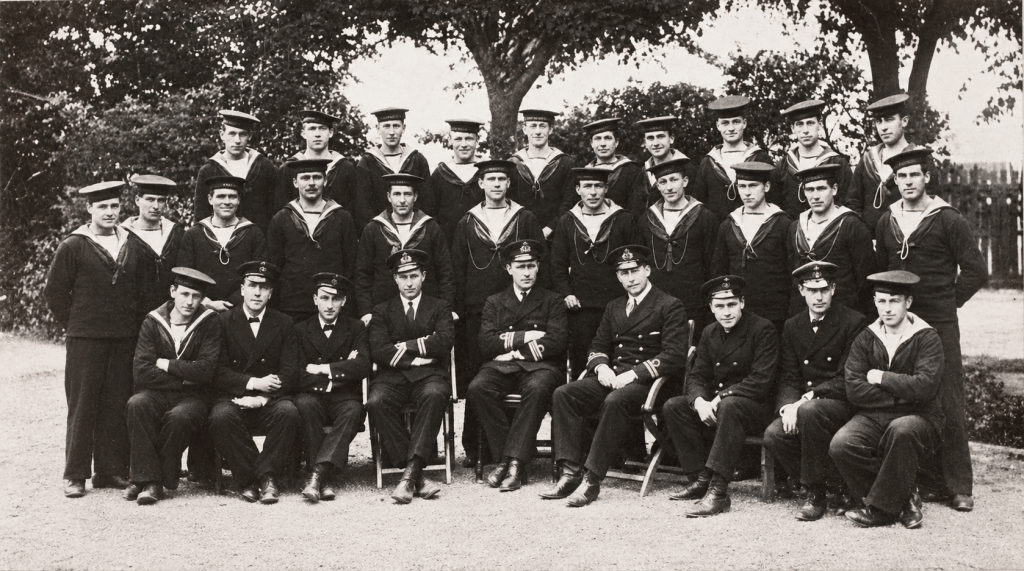
Photograph credited to C.N., originally published in The Illustrated War News, 25 August 1915.
The Final Voyage of E13
On 14 August 1915, HMS E13, with her crew of 30, set out from Harwich accompanied by her sister submarine, HMS E8. Their destination was the Baltic Sea, where they were to patrol and intercept German shipping, particularly vessels carrying iron ore from Sweden.
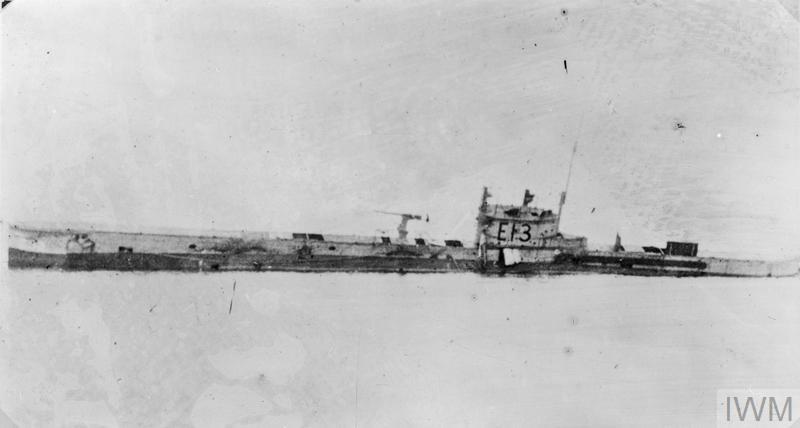
Five days later, on 19 August, E13, commanded by Lieutenant-Commander Geoffrey Layton, suffered a failure of her gyrocompass while attempting to navigate the Danish straits. As a result, the submarine ran aground near the Danish island of Saltholm in the Øresund.
The submarine was stranded in Danish territorial waters and repeated efforts to refloat her were unsuccessful. A Danish torpedo boat arrived and informed Layton that he would be allowed 24 hours in which to attempt to free his vessel.
German naval forces were also aware of the submarine’s predicament. A German destroyer initially remained near E13 but withdrew following the arrival of additional Danish torpedo boats.
The presence of the Danish vessels should have emphasised that E13 was within the waters of a neutral country.
Later that morning, however, two German torpedo boats approached the stranded submarine.
One of them signalled for the crew to leave their vessel. Before Lieutenant-Commander Layton had sufficient time to read and respond to the signal, an attack began. A torpedo was fired towards E13 but struck the bottom close to the submarine and exploded without destroying her.
The Germans then opened fire with their guns.
E13 was aground, unable to manoeuvre and effectively incapable of defending herself. Shellfire struck the submarine and fires broke out fore and aft. Realising that remaining aboard was impossible, Layton ordered his men to abandon ship.
The attack did not immediately end when the sailors entered the water. According to Layton’s subsequent account, the men were subjected to machine-gun and shrapnel fire as they attempted to escape from the burning submarine.
The Danish torpedo boat Soelven intervened, lowering boats to assist the British sailors and manoeuvring between E13 and the German vessels. Faced with the Danish warship, the Germans ceased firing and withdrew.
“I Had Never Witnessed Any Bravery to Equal It”
Reports of the attack quickly reached the British press.
A Danish fisherman who had been aboard one of the boats close to E13 was interviewed by the Copenhagen newspaper Politiken. His account particularly emphasised the conduct of the British sailors.
He said that he had “never witnessed any bravery to equal that displayed by the crew of the E13.”
According to the fisherman, the men remained quiet as the Germans began shelling their stranded submarine. Realising that escape appeared impossible, they watched events unfold with remarkable composure.
The incident caused considerable anger in Denmark. Danish newspapers regarded the attack upon a stranded British submarine inside Danish waters as a serious violation of the country’s neutrality. The Danish Government protested to Germany, while newspapers called for an apology and guarantees against any repetition.
The Dead of E13
The loss of life was considerable.
The bodies of the British sailors were taken ashore at Copenhagen in scenes which contemporary reports described as deeply moving. A Danish naval vessel entered Langelinie with its flag at half-mast, while a naval squadron provided a guard of honour.
Flags at Danish fortifications and aboard ships were lowered in respect. Hundreds of people gathered as the bodies were carried ashore one by one, and contemporary accounts recorded that some of the spectators and soldiers were moved to tears.
At St Alban’s British Church in Copenhagen, the Reverend Kennedy made reference to the dead of E13 and the organ played the “Dead March”, while the congregation, including many Danish people, remained standing.
Arrangements were subsequently made for the dead to be returned to Britain aboard the Danish mail steamer Vidar, whose saloon was temporarily converted into a chapel.
One sailor, however, was still missing.
The Recovery of Henry Pedder
That man was Henry Pedder.
His fate was finally reported by the Derry Standard on 27 August 1915. In an unusual conclusion to the tragedy, it was a German torpedo boat which eventually found Pedder’s body.
The Germans transferred his remains to the Danish torpedo boat Narhvalen, which carried him to Copenhagen. His body had been recovered later than those of the other 14 sailors who had lost their lives, and consequently he was not returned to Britain with them.
The bodies of the other 14 men were repatriated by the Danish Government aboard the Danish ship Vidar. The ship arrived at Hull on 28 August 1915.
Henry Pedder’s remains were returned to Britain separately at a later date. He was subsequently laid to rest in the Royal Naval Cemetery at Haslar, Gosport, Hampshire, where he is commemorated by the Commonwealth War Graves Commission.
Pedder had been just 27 years old when he lost his life on 19 August 1915. After more than a decade in the Royal Navy, his final posting had placed him aboard a submarine which was attacked while stranded and helpless within the territorial waters of a neutral country.
The 15 surviving members of the crew were interned by the Danish authorities for the duration of the war, although the captain and another officer later managed to escape and return to Britain, where they resumed their naval service.
The Danish authorities subsequently refloated the submarine and towed it to Copenhagen, but the vessel remained unserviceable. In 1919, it was sold by the British Government to a Danish company and was subsequently scrapped.
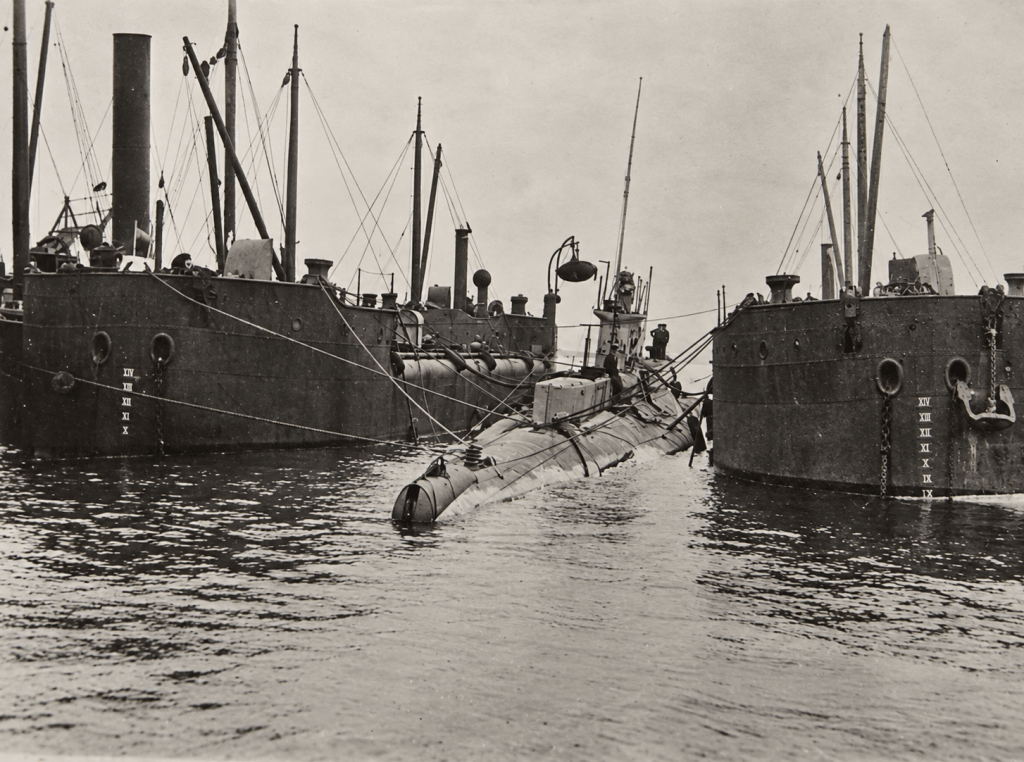
Photograph, originally published in The Manchester Guardian, 1915.
Family
Henry Thomas Pedder was born on 15 April 1888 at Crawley, Sussex. The following information has been ascertained from the 1891 and 1901 Census and the Service Records.
The following family information has been ascertained :-
- Father: Henry George, born c.1846 at Uxbridge, Middlesex. (Farmer)
- Mother: Amelia, born c.1860 at Portsmouth, Hampshire.
- Sister: Amelia, born c.1886 at Horley, Sussex.
- Brother: George H.J., born c.1887 at Horley, Sussex.
- Brother: Alfred, born 17 February 1890 at Copthorne, Sussex.
- Sister: Elizabeth Mary, born c.1895 at Copthorne, Sussex.
Addresses
Records show that Henry lived in:
- 1891: Copthorne, Sussex. (Census)
- 1901: Allingham Farm, Copthorne, Sussex. (Census
- 1915: The Retreat, Bosham, Sussex.
Medals
Henry Pedder was awarded the 1914-15 Star, the Victory and the British War Medals for his service in the Great War.
Memorials
He is honoured and remembered on the following memorials :-
- St Saviour’s Parishioners, Woodbridge Road, Guildford, Guildford, Surrey, GU1 4QD.
- Chidham Parish, Cot Lane, Chidham, Chichester, West Sussex, PO18 8SX.
- The Royal Navy Submarine Museum, Gosport, Hampshire.
Remarks
Henry’s brother, Alfred, also joined the Royal Navy, entering the service on 7 March 1917 as an Officer’s Steward, 3rd Class, L/10131. His naval record indicates that he was invalided out of the service on or about the 29 March 1918.
Royal Navy service records from the First World War did not generally record the particular submarine to which a sailor was attached, unless the vessel was lost in action, as was the case with Henry Pedder. Henry’s record lists several submarine depot ships and establishments, but provides little direct evidence identifying the individual submarines on which he served. Nevertheless, his service record suggests that he spent a considerable part of his naval career serving with the submarine service.
Links to Additional Information
- Find a Grave website: Henry Thomas Pedder.
- Commonwealth War Graves Commission: Henry Thomas Pedder.
- A Street Near You: Henry Thomas Pedder.
- Lives of the First World War: Henry Thomas Pedder.
References
- Commonwealth War Graves Commission.
- The Standard Newspaper dated 23 August 1915 page 8. (B.N.A.)
- 1891 Census. (Ancestry)
- 1901 Census. (Ancestry)
- Navy Death Records. (Ancestry)
- Register of Seamans Services. (Ancestry)
- Pension Cards. (Western Front Association)
- Naval Medal and Awards Roll. (Ancestry)
- Royal Navy and Royal Marine War Graves Roll. (Ancestry)
- Illustrated War News: 25 August 1915. (Crew Photo)
- The Manchester Guardian: 1915 (Photo of Salvaged Submarine)
- Imperial War Museum Photographic Website.
- Le Petit Journal: 12 September 1915. (Illustration)
Groups
Contributors:-
- Vincent Stuart (Main Article)

