7th Gordon Highlanders,
24th July 1918
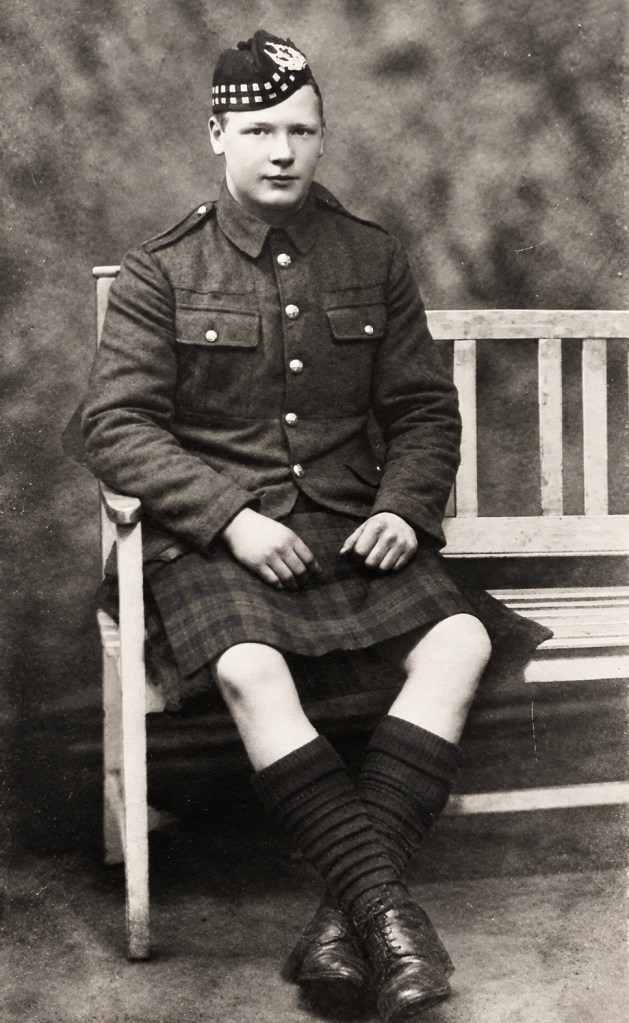
Synopsis of Life and Military Service
Alexander Grant
Alexander Grant was born on 13 August 1898 at Keith, Banffshire, the youngest son of James Grant and his wife Elizabeth, née Burgess. His mother was a daughter of the late William Burgess of Park Head, Botriphnie.
The family lived in Keith, with records giving addresses at both 20b Mid Street and, later, 27b Moss Street. Alexander was educated locally at Keith Grammar School.
Enlistment and Military Service
With the First World War already in its third year, Alexander enlisted into the Gordon Highlanders on 23 April 1917, when he was 18 years old. He initially joined the 3rd Battalion, Gordon Highlanders and was given the service number 17707.
Following his training in Britain, Alexander was sent to France to join the British Expeditionary Force on 29 March 1918. He was subsequently transferred to the 7th Battalion, Gordon Highlanders.
His arrival in France came at a particularly difficult period for the British Army. The German Spring Offensive had begun only days earlier and heavy fighting was taking place across large areas of the Western Front.
The Fighting near Rheims
By July 1918, Alexander and the 7th Gordon Highlanders were serving in the Rheims sector. Between 20 and 24 July the battalion was involved in operations around the Bois de Courton, south-west of Rheims, during which Alexander was killed.
The battalion’s Operations Report records that at 8 a.m. on 20 July the men advanced behind an artillery barrage. Initially they encountered relatively little resistance and prisoners were taken rapidly. However, on reaching the edge of the Bois de Courton, the situation changed considerably.
Heavy machine-gun fire was encountered from within the wood and the density of the trees and undergrowth made it extremely difficult for the advancing troops to maintain their direction or even their correct positions. As the morning progressed, the situation became increasingly confused, with neighbouring units held up and sections of the attacking force becoming separated from one another.
Some troops succeeded in reaching the outskirts of Les Haies but, with their flanks exposed and insufficient numbers to hold the position, they were forced to withdraw. Significantly, the Operations Report recorded:
“It is possible some of the missing men may be accounted for at this time.”
By nightfall the battalion had withdrawn to the Paradis-Espilly Line and began consolidating its position. The fighting that day was described as being of a “strenuous nature”, with German machine-gun positions providing particularly effective resistance.
The 7th Gordons were relieved during the night of 20–21 July. Such had been their losses that on the following morning the battalion was reorganised into just two companies. Although the men remained close to the fighting over the following days, much of their role was subsequently in support of other units.
The battalion’s casualties for the operations between 20 and 24 July amounted to one officer killed and eight wounded. Among the other ranks, 18 were killed, 176 wounded and 24 reported missing, with a further man dying of wounds and another recorded as wounded and missing.
When Was Alexander Killed?
The precise date of Alexander’s death remains uncertain.
De Ruvigny’s Roll of Honour records that he was:
“killed in action near Rheims 20-24 July”
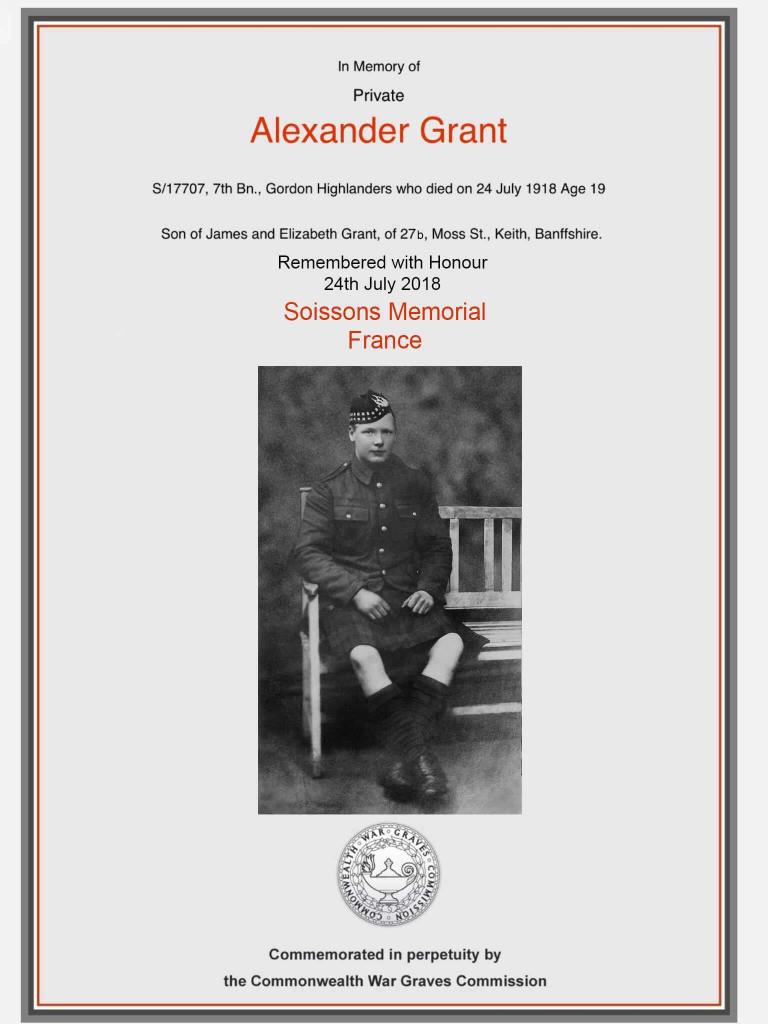
Most of the documents investigated similarly place his death sometime between 20 and 24 July 1918. The Commonwealth War Graves Commission has adopted 24 July as Alexander’s official date of death.
There is, however, evidence to suggest that he may have been killed or gone missing during the much heavier fighting on 20 July.
The Operations Report demonstrates that 20 July was by far the most confused and costly period of the battalion’s operations. Men became separated in the dense Bois de Courton, units lost touch with one another and some troops advanced with their flanks exposed before being forced to withdraw. The report itself acknowledged that some of the battalion’s missing men may have been lost during this stage of the fighting.
In contrast, the entry for 24 July records that “nothing of importance happened” other than periods of hostile shelling, much of which fell on the rear areas. During the relief that evening, three men were wounded by gas shelling.
Although it is impossible from the surviving evidence to establish Alexander’s date of death with certainty, the circumstances recorded in the battalion’s own Operations Report make 20 July 1918 a strong possibility.
Alexander was just 19 years old.
No Known Grave
What subsequently happened to Alexander’s body is also uncertain. It was either never recovered from the battlefield or was recovered but could not later be identified.
De Ruvigny’s Roll of Honour, however, provides an intriguing detail, stating that Alexander was:
“Buried at Marfaux, south-west of Rheims.”
Despite this statement, Alexander has no identified grave today.
His family believe that his body was recovered and that he may lie amongst the unidentified soldiers buried in Marfaux British Cemetery, Marne, France. In the absence of further evidence, however, it is not presently possible to confirm this.
As a soldier with no known grave, Alexander is officially honoured and remembered on the Soissons Memorial, Aisne, France.
The memorial bears the names of those who died during the fighting in the region and whose graves are unknown. It therefore remains Alexander’s official place of commemoration, although the statement in De Ruvigny’s Roll of Honour leaves open the possibility that his remains were recovered from the battlefield and that he now rests, unidentified, at Marfaux.
Report on 7th Gordon Highlanders Action in the Operations on 20-24th July 1918
The following is an extract from the above Operations Report for the Operations from 20th to 24th July 1918, the dates between which Alexander Grant was killed.
At ZERO (8 a.m.) the Barrage came down and the advance commenced. Little opposition was at first offered by the enemy, and the counter barrage was considered slight being mostly on back areas. Prisoners came in rapidly and mostly from outpost positions, the outposts offering little opposition, and in some cases being captured before putting on equipment, some of them having evidently been asleep. On reaching edge of BOIS de COURTON running along FLEURY-BULLIN Road more opposition was met with including heavy machine gun fire from wood. From this point onwards considerable difficulty was experienced by all concerned in maintaining their proper positions and direction on account of the density of the wood and undergrowth. At 9 a.m. Battalion Headquarters were moved forward about 600 yards and established in close proximity to 6th Black Watch. Between 9 and 9.30 a.m. hostile shelling became heavier and at 9.30 a.m. it was reported that the 6th Black Watch were being held up in the wood. The position all round at this time was obscure and remained so till about 11.30 a.m., and it was evident touch had not been established with 154th Brigade on right whose advance had been held up. This subsequently proved to be correct.
At 9,45 a.m. Lieutenant Stewart was sent to reconnoitre and clear up the situation. He returned at 12.10 p.m. with valuable information and reported on the general situation, his reconnaissance being of very considerable importance in clearing up the situation. He thereafter proceeded to Brigade Headquarters and reported the situation. The details of his observations latterly proved to be very accurate.
At 11 a.m. hostile artillery became more active in region of LES HAIES and position all round was very obscure. At 11.40 a.m. I issued orders to my two Right Companies to immediately protect their flanks and this was complied with and had been already practically completed. Certain elements of the Brigade had by this time reached the outskirts of LES HAIES but, being in small numbers with both flanks in the air, they were withdrawn to the line. It is possible some of the missing men may be accounted for at this time.
at 12.15 p.m. it was reported that the 6th Black Watch had gained parts of the Blue Line and were in touch with French (Senegalese) on left in vicinity of Green Line. It was then decided to consolidate on the Line (see attached Map marked in Brown) and this was proceeded with, but later in the afternoon it was considered expedient to evacuate this line on account of the position on our right and left flanks, and by night fall all troops were withdrawn to the PARADIS-ESPILLY Line, touch established with 154th Brigade (on right) about the point – Junction of Roads at O in BOIS de COURTON (marked 2). Consolidation was immediately carried out on this line. The intended objectives were not gained and elements of all Units came together.
During the day the fighting was of a strenuous nature but consisted principally of machine gun defence which in many places was most effective. Considerable use was made of Lewis Guns in knocking out Machine Gun nests and the action of the Lewis Gun Teams was most effective all through.
The Battalion was relieved on night 20th-21st July by 6th Seaforth Highlanders, and moved back to Wood near Brigade Headquarters.
On the morning of 21st July 1918 the Battalion concentrated in Wood near Brigade Headquarters at 6 a.m. and was rapidly reorganised into two Companies under Lieutenant Gregor and Captain Meldrum respectively, and at 6.40 a.m. were prepared to move off on 10 minutes notice. At 6.50 a.m. the Battalion was moved to position in French Trench to be in readiness to assist in forming Flank Defence for the 6th Gordon Highlanders who were to advance. ZERO hour 8 a.m. – I immediately gained touch with O.C. 6th Gordons and was asked to remain where I was till he sent me further word of the progress of the attack on his front. At 12.40 p.m. he reported his Battalion had reached far edge of Wood (BOIS de COURTON) during the early forenoon and that the enemy were found to be in great strength beyond the Wood, and it was impossible to push forward any further, and that owing to difficulty of keeping touch in the Wood his men had been in some cases outflanked and most of them had been forced to fall back on a line within 100 yards of the jumping off position, and his right flank in the air. At this stage I ordered my two Companies forward to form if necessary the defensive flank, but they were not utilised as O.C. 6th Gordons had by this time gained touch with his flanks.
My Companies therefore remained in close proximity to 6th Gordons Headquarters ready to move immediately, but were not employed, and ultimately one Company returned about midnight to position in French Trench in close proximity to my Battalion Headquarters, one Company remaining in BOIS de COURTON in close support to 6th Gordons.
During the morning of 22nd July considerable hostile artillery actively was maintained from 1 a.m. to 3.10 a.m. when an S.O.S. Signal was sent up from the Brigade on our right. Our barrage came down very promptly and nothing seems to have happened. Gas Shelling occurred between 4.30 and 6 a.m. During the afternoon of 22nd July the position near Battalion Headquarters was subjected to intense hostile artillery fire and I decided to evacuate to a position 600 yards in rear with one Company and Headquarters. This was completed about 4.30 p.m. During that evening the 8th Royal Scots relieved the 6th Gordons and one Company 7th Gordons was placed at their disposal for front line. It was found unnecessary to employ this Company and it remained in support.
On 23rd July at 2.45 p.m. orders were received to place two Platoons of 7th Gordons at disposal of 154th Infantry Brigade and to get in touch with 4th Gordons. No definite orders ever reached me about these Platoons, and on their being sent to report to 4th Gordons nothing was known about them. They remained in close support to that Battalion for the night of 23rd-24th July but were withdrawn by me in the forenoon of 24th July 1918.
On the 24th July nothing of importance happened unless intermittent periods of hostile shell fire which at times became intense and particularly on back areas. During the evening the Battalion was relieved in support by the 35th French Infantry Regiment and marched to bivouacs in wood near ST IMOGES reaching there about 10 p.m. some small Units of the Battalion being subjected to Gas shelling during relief and suffered 3 casualties, wounded. The liaison maintained with French was, the French doing all they could to help us, especially those in our vicinity.
Total Casualties for Phase
- Officers – 1 killed, 8 injured.
- Other Ranks – Killed – 18, Wounded 176, Missing – 24, Died of Wounds – 1, Wounded and Missing – 1.
Officers – 1 killed, 8 injured.

Family
Alexander Grant was born on 13th August, 1898 at Keith, Banffshire. The following family information is taken from the 1901 Census.
His family is shown as follows :-
- Father: James Grant, born c.1853 at Tomintoul, Banffshire – Shepherd.
- Mother: Elizabeth Burgess or Grant, born c.1863 at Botriphnie, Banffshire.
- Brother: William, born c.1889 at Keith, Banffshire.
- Brother: James, born c.1890 at Keith, Banffshire.
- Brother: John, Born c.1894 at Keith, Banffshire.

Addresses
The following addresses have been ascertained from the 1901 Census, Pension Cards and the Commonwealth War Graves Commission.
- 1901 Census: 15 Broomhill Road, Botriphnie, Banffshire.
- De Ruvigny’s Roll of Honour: 20b Mid Street, Keith, Banffshire.
- C.W.G.C.: Family address: 27b Moss Street, Keith, Banffshire.
Medals
Alexander Grant was awarded the, Victory and the British War Medals for his service in the Great War.

Memorials
Alexander Grant is honoured and remembered on the following memorials :-
Links to Additional Information
- Commonwealth War Graves Commission: Alexander Grant
- Lives of the First World War: Alexander Grant
- A Street Near You website: Alexander Grant
- Find a Grave: Alexander Grant – Soissons Memorial
References
- Medal Index Card. (Ancestry)
- Commonwealth War Graves Commission.
- De Ruvigny’s Roll of Honour.
- Register of Soldiers Effects. (Ancestry)
- 1901 Census. (Ancestry)
- Medal Roll: Gordon Highlanders – Victory and British War Medal. (Ancestry)
- Soldiers Died in the Great War. (Ancestry)
- War Diary of the 7th Gordon Highlanders. (The National Archive)
- Pension Cards. (Western Front Association)
Groups
Contributors:-
- Vincent Stuart(Main Article)
- Ian Grant (Family Photos)

