27th Battalion (City of Winnipeg), Canadian Infantry, 16 October 1918

Synopsis of Life and Military Service
George Bain McIntosh Edgar was born on May 6, 1885, in the small Scottish parish of Birnie to his mother, Catherine “Kettie” Harrold (1851-1904), and, his father, George Edgar (1985-1917) after whom he was named. His early years were spent on the family farm at North Castlehill, Alves, where he developed a strong work ethic that would define much of his life. He grew up surrounded by his siblings, including William (born in 1887), Margaret (born in 1889), Frank (born in 1890), Robert (born in 1894), Isabella-Jean (born in 1897). Life on the farm was hard, but it instilled in him the values of perseverance and responsibility. Tragically, George’s life would end far too soon, at the age of 33, under unexpected and heartbreaking circumstances.
Early Adulthood
In 1901, George had left the family home, already beginning his life of busy work. At the age of 15, he was recorded as a “ploughman” in Lower Hempriggs, Alves; serving and lodging at the Gray family farm. This style of working continued, as by 1906, at the age of 21, George was working for Alfred and Kate Mutchie – recorded as “servant”.
George soon sought greater opportunities and decided to embark on a new adventure. That same year, he boarded the great ship, Corinthian, in Glasgow, bound for Montreal, Canada, where he would start a new life. He arrived in Canada on 6 June 1906, eager to embrace the opportunities that lay ahead in this vast and promising land.
George settled in Manitoba, where he found labour work and lived for several years. By the time of the 1911 census, he was recorded as a lodger with the Duncan family—Anna and Alexander—another testament to his transient but determined lifestyle as he pursued a better future in Canada.
A Call to Serve
Like many young men of his time, George was caught up in the tide of global events when the First World War broke out. George was drafted under the Military Service Act, which had been passed in late August of 1917. The act required all able-bodied male citizens between the ages of 20 and 45 subject to military service, if called, for the duration of the war. Upon receiving his summons on behalf of the Canadian government, George registered at the Austin Post Office in Manitoba on 14 January 1918. A devout Presbyterian, George was classified as “A2” in terms of fitness for service, which meant he was deemed fit for duty and ready to serve his adopted country. His strong frame, standing 5 feet 10 inches tall, with blue eyes and brown hair, made him an ideal candidate for military service. George made his way through his initial training, and arrived in France as a Private in the 27th Canadian Battalion in July 1918. However, George’s war experience would be defined not by heroic battles but by a tragic accident that would claim his life.
The Tragedy of October 1918
On 14 October 1918, while stationed at the front, George’s life was cut short in an accidental shooting. Private Dominico Deluca, a fellow soldier, was cleaning a German revolver when it accidentally discharged, striking George. The bullet inflicted a grievous wound to his abdomen. Despite the efforts of medical personnel, George could not recover from the injury.
A witness to the incident, Lieutenant J.W. Pidgeon, confirmed the tragic event, along with two Privates, W.E. Cassels and W. Rae. George had been an innocent victim of a fatal accident, rather than the direct consequences of enemy fire. The tragic irony of this incident was that George, a man who had worked so hard for a better life, and who had survived the worst that war could offer, lost his life due to an avoidable accident just weeks before the war’s end.
Remembering George
George Bain McIntosh Edgar’s death is a poignant reminder of the countless lives that were affected, and in many cases lost, during the Great War—not always in battle, but through the tragic accidents that occurred on the front lines. He was a farmer, a brother, an immigrant seeking a new life, and a soldier. He left behind his father and siblings, who had watched him grow into a man and hoped to see him return home safely. Though his life ended at 33, George’s story is one of resilience, sacrifice, and the sad reality of the countless lives altered by war.

War Diary of the 27th Canadian Infantry
The following is an extract of the War Diary of the 27th Canadian Infantry during the period of his wounding.
13 October 1918
Location – Epinoy: Battalion in billets in Epinoy (Approx. R.34.c and d.) Sheet 51E. SE. Details at X.23.b. Weather dull and showery. Wind N.E., Lieutenants E.P. Gilbert, MM, C.M. McEwen, F.Y. Greensted and H.I. Terrell and Captain V. Curran. S.O.S. (Struck off Strength). Part 2 Orders No. 94 d/ 13.10.18. Wounded 5 O.R.s (Other Ranks), Died of Wounds 1 O.R. Reinforcements – Lieutenant C.R. Atkinson, DCM, MM, Lieutenant H.A. Driver and Lieutenant W.W. McDonald, MM arrived.
14 October 1918
Location – Epinoy: Weather fine, wind NW. Battalion at EPINOY. On night 14 / 15th October the Battalion relieved the 25th and 26th Battalions in line along the Canal bank. Battalion HQ, at BATIGNY approximately M.34.d.50.20, sheet 51A. SW. Casualties 1 Other Rank Wounded.
15 October 1918
Weather fair, Wind SW, Battalion in Front Line, disposed of as on 14th inst. Details at SAILLY. Casualties 1 Other Rank Killed in Action, 3 Other Ranks Wounded. 1 O.R. Reinforcement arrived.
Family
The following family information has been ascertained from several sources including the 1891 and 1901 Census :
- Father: George B.M. Edgar, born c.1865 at Nairn, Nairnshire. (Stone Carter) (d.1917)
- Mother: Catherine “Kettie” Harrold or Edgar, born c.1851 at Kellas, Morayshire. (d.1904)
- Brother: William, born c.1887 at Duffus, Morayshire. (d.1963)
- Sister: Margaret “Maggie”, born c.1889 atDuffus, Morayshire. (d.1966)
- Brother: Frank, born c.1890 at Cummingston, Morayshire. (d.1966)
- Brother: Robert, born c.1894 at Cummingston, Morayshire. (d.1979)
- Sister: Isabella-Jean Marshall or Edgar “Isa” born c.1897 at Cummingston, Morayshire.
George and his brother, Robert, had both, though separately, emigrated to Canada; Robert remained in Canada after George’s death. The Edgar family back home remained in Cummingston, Scotland and continued to persevere, with descendants still living in the small, rural village today.
Medals
George Edgar was awarded the Victory and the British War Medals for his service in the Great War.
Burial
George Edgar is honoured and buried at Bucquoy Road Cemetery, Ficheux, Pas de Calais, France.
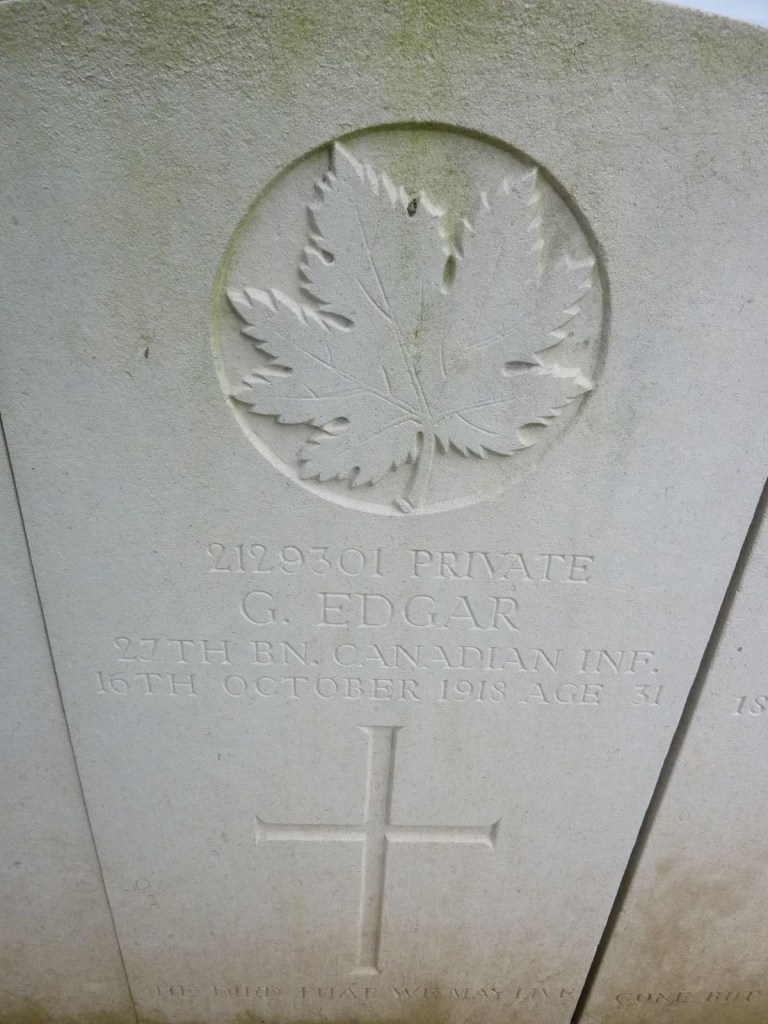
Memorial
George Edgar is honoured and remembered on the following memorials:-
- Cummingston War Memorial, Moray, Scotland
Links to Additional Information
- Commonwealth War Graves Commission: George Edgar.
- Find a Grave website: George Edgar.
- A Street Near You: Private George Edgar.
- Lives of the First World War: George Edgar.
- Canadian Visual War Memorial: George Edgar
- Canadian Service Record: George Edgar
- War Diary 27th Canadian Infantry
References
- Morayshire Roll of Honour 1921 (p.102: Edgar, George).
- 1891 Scottish Census
- 1901 Scottish Census
- Find a Grave® Index – Private George Edgar
- Canada, World War I CEF Attestation Papers, 1914-1918
- Canada, World War I CEF Personnel Files, 1914-1918
- 1911 Census of Alberta, Canada
- Moray, Scotland, Local Heritage Index, 1632-2014
- Canada, War Graves Registers (Circumstances of Casualty), 1914-1948
- 1906 Canada Census of Manitoba, Saskatchewan, and Alberta
- Canada, Virtual War Memorial Index, 1900-2014
- Scotland, World War I Rolls of Honour, 1914-1918
- Canada, CEF Commonwealth War Graves Registers, 1914-1919
- Canada, Incoming Passenger Lists, 1865-1935
- UK and Ireland, Outward Passenger Lists, 1890-1960
- Marcus, P. (1940). Some Aspects of Military Service. Mich. L. Rev., (39, p.913).
- Imperial War Museum War Memorial Register: 57752, Cummingston, Scotland.
Groups
Contributors:-
- Sasha Cameron (Main Article)
- Claude Laignel (Photo of Grave)
 WW1 LIVES