4th Battalion, Canadian Pioneers,
2 Septemer 1916
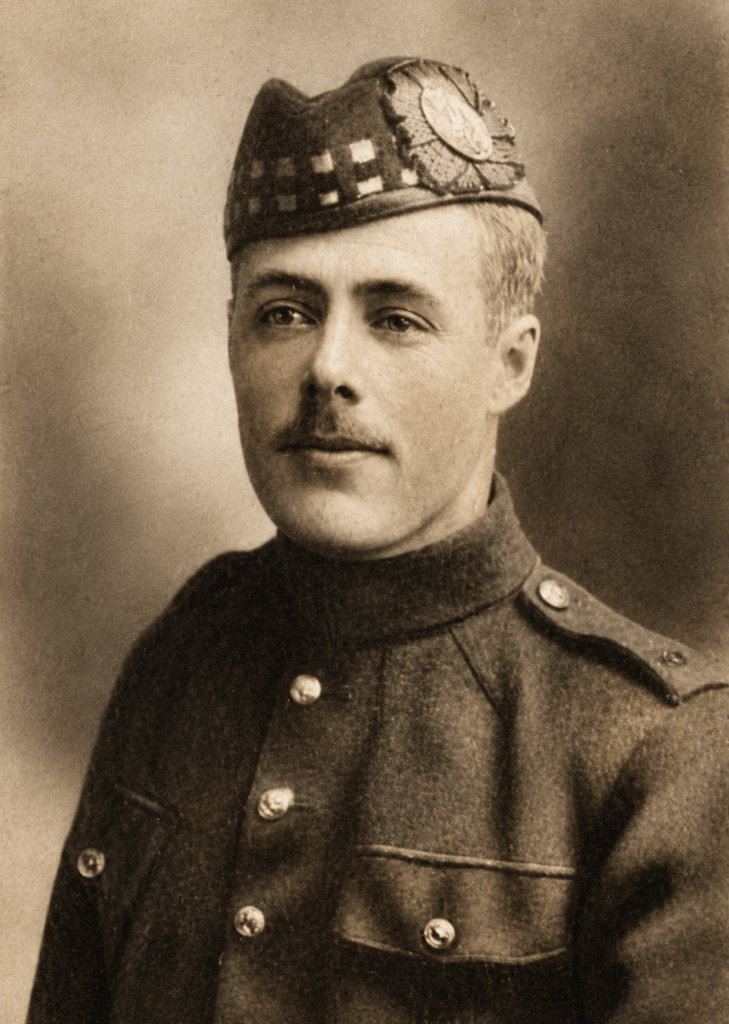
Synopsis of Life and Military Service
The Scottish Banker Who Chose the Front Line
Early Life in Aberdeenshire
Alfred Campbell was born on 25 May 1892 in Aberdeenshire, Scotland, the son of Sylvester and Isabella Isaacs Campbell of Kinellar Farm, Kinaldie, near Kinellar. Raised in rural Aberdeenshire, Alfred received his education locally before embarking upon a career in banking.
Following his schooling, he entered the service of the North of Scotland and Town and County Bank Ltd., where he remained for approximately five years. His ability and diligence earned him a respected position within the banking profession, and in 1913 he decided to seek new opportunities overseas.
A New Life in Canada
In August 1913, Alfred emigrated to Canada and settled in Victoria, British Columbia. There he joined the staff of the local branch of the Bank of British North America and quickly became a valued member of both the bank and the wider community.
During his time in Victoria, he resided with Mr. and Mrs. A. S. Christie, 845 Princess Avenue and worshipped at the First Presbyterian Church. Friends and colleagues remembered him as a conscientious young banker who maintained close ties with his family in Scotland.
Enlistment for War
With the Great War continuing into its second year, Alfred answered Canada’s call for volunteers. On 13 October 1915, he enlisted at Victoria, British Columbia, joining the 67th Battalion (Western Scots), Canadian Infantry.
At the time of enlistment, he was 23 years old, single, and employed as a bank clerk. His military records show that he had no previous military experience.
He was described as:
- Height: 5 feet 7 inches
- Weight: 144 pounds
- Chest: 33 inches with 3-inch expansion
- Complexion: Fresh
- Eyes: Grey
- Hair: Dark brown
- Religion: Presbyterian
His records noted no distinguishing marks, scars, or tattoos.
Crossing the Atlantic
On 1 April 1916, Alfred embarked from Halifax, Nova Scotia, aboard the famous passenger liner RMS Olympic, sister ship of the ill-fated Titanic. After an eleven-day voyage across the Atlantic, he arrived at Liverpool on 12 April 1916.
Like many Canadian soldiers, he spent several months training in England before receiving orders for active service. During this period he was able to return home and visit his family in Aberdeenshire, likely knowing that it might be the last time he would see them.
Before proceeding overseas, Alfred demonstrated the careful and responsible nature that had characterised his banking career. On 5 August 1916 he signed his Will, leaving all monies due to him to his mother, Isabella Campbell. He appointed John Charles, Bank Agent of Inverurie, and the Reverend Robert Littlejohn Barr of Kinellar Parish as his executors.
Only days later, he left England for the Western Front.

To France and Flanders
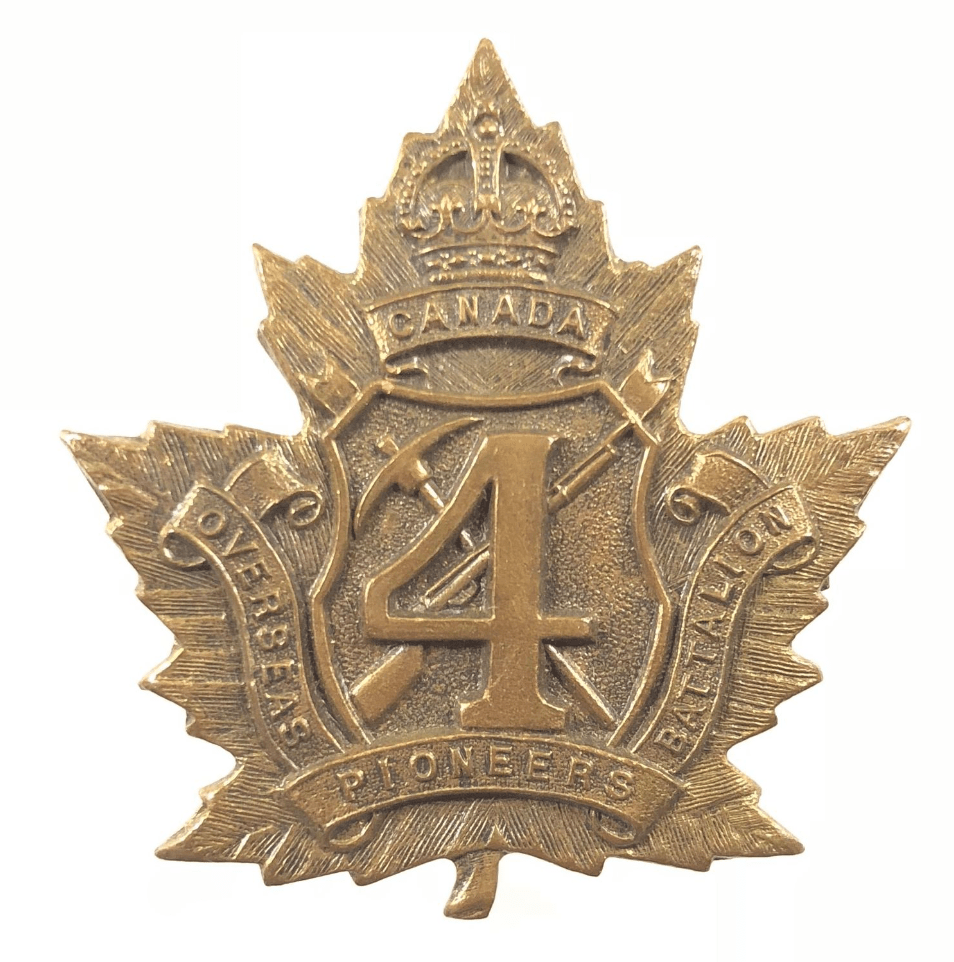
Alfred departed England on 13 August 1916, arriving in France the following day. At some stage after 5 August 1916, when he signed his Will as a member of the 67th Battalion, he was transferred to the 4th Battalion, Canadian Pioneers. The exact date and location of this transfer have not been established, and it may have taken place either before or after his departure for France.
The 4th Canadian Pioneer Battalion carried out a wide range of vital but hazardous duties in support of the Canadian Corps. Their responsibilities included constructing and repairing trenches, building roads and strongpoints, laying and maintaining barbed wire defences, and preparing the ground for infantry assaults. Much of this work was undertaken within range of enemy artillery and under direct observation from German positions. As a result, Pioneer battalions often endured casualties comparable to those suffered by front-line infantry units, despite their primarily engineering and labouring role.
Although Alfred’s experience as a bank clerk made him an ideal candidate for administrative work, he declined several opportunities to leave the front line to take up that role.
According to accounts published after his death, he was twice offered clerical appointments behind the lines in positions of comparative safety. Each time he refused, choosing instead to remain alongside the men with whom he had enlisted.
One memorial account later recorded:
“He preferred to remain in the trenches among the friends with whom he had enlisted.”
Mount Kemmel
By the end of August 1916, Alfred had been in Belgium for only a matter of weeks.
On the night of 1 September 1916, while serving in the Mount Kemmel (Kemmelberg) a relatively quiet, defensive “rest” sector in the Ypres Salient, Belgium, he was struck by enemy rifle fire. Contemporary newspaper reports stated that he was shot in the breast during operations.
He was evacuated to a dressing station, but the wound proved fatal. Military records record a bullet wound to the left side of his chest.
Despite medical attention, Alfred survived only a few hours.
He died of wounds on 2 September 1916, aged just 24 years.
Private Mackenzie, another soldier from Victoria who was with him when he fell, later conveyed news of his death to the Christie family in Canada.
Burial and Commemoration
Alfred was buried in Reninghelst Military Cemetery, Belgium, where he rests amongst many other Commonwealth servicemen who died in the Ypres Salient.
His sacrifice was also remembered in the memorial book of the Bank of Montreal, which honoured employees of the Bank of British North America and related institutions who lost their lives during the Great War.
His Estate
Although only twenty-four years of age, Alfred had accumulated considerable savings through his banking career.
His estate was confirmed in Aberdeen in February 1917, with a value of £725, a substantial sum at the time. A further confirmation in July 1918 recorded additional estate valued at £600.
The probate records described him as:
“Bank Clerk, Kinellar Farm, Parish of Kinellar, sometime of the 67th Battalion Western Scots of Canada, latterly of the 4th Canadian Pioneer Battalion.”
His mother Isabella was the principal beneficiary of his estate, while administration was carried out by the executors he had carefully appointed shortly before going overseas.
Remembering Alfred Campbell
Alfred Campbell’s story is one shared by many young Scots who sought opportunity overseas before the outbreak of war. A successful banking career had taken him from rural Aberdeenshire to the growing city of Victoria on Canada’s Pacific coast. Yet when war came, he volunteered to serve the country that had become his new home.
What makes his story particularly poignant is that he consciously rejected safer duties. Twice offered positions behind the lines that would have utilised his professional skills, he chose instead to remain beside his comrades in the trenches.
His service in France and Belgium lasted less than three weeks before a single bullet ended a promising life. He was only twenty-four years old.
Today, Alfred Campbell rests far from both Aberdeenshire and British Columbia, buried in the peaceful surroundings of Reninghelst Military Cemetery. His grave stands as a reminder of a young banker who placed duty and comradeship above personal safety and paid the ultimate price during the Great War.
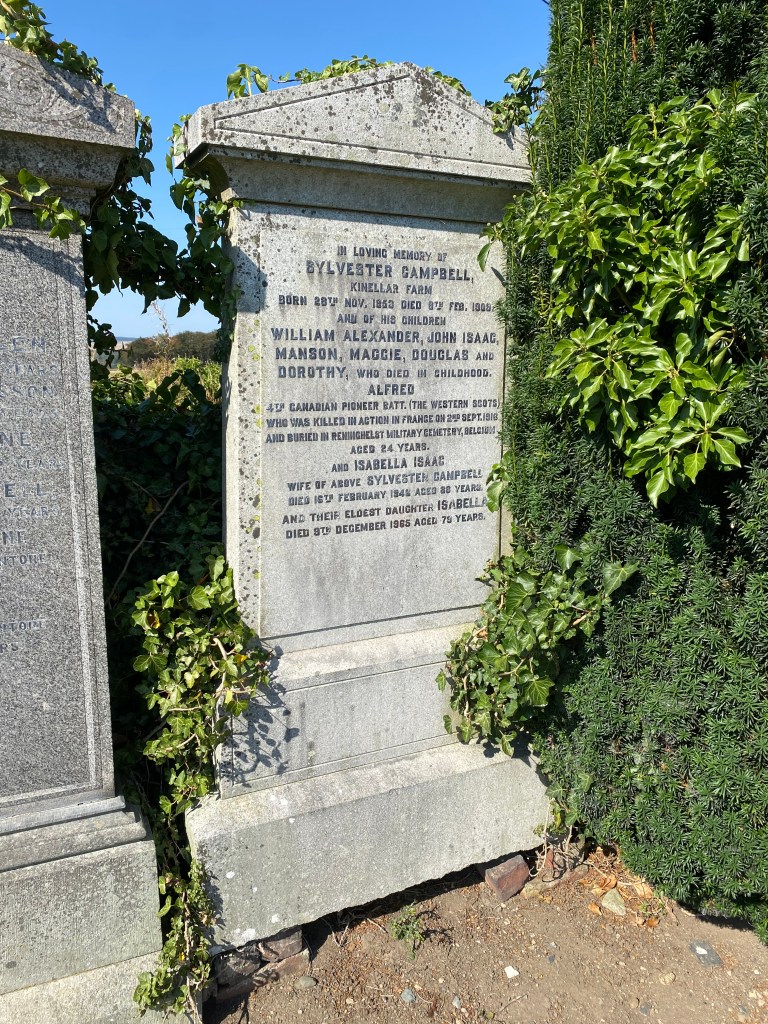
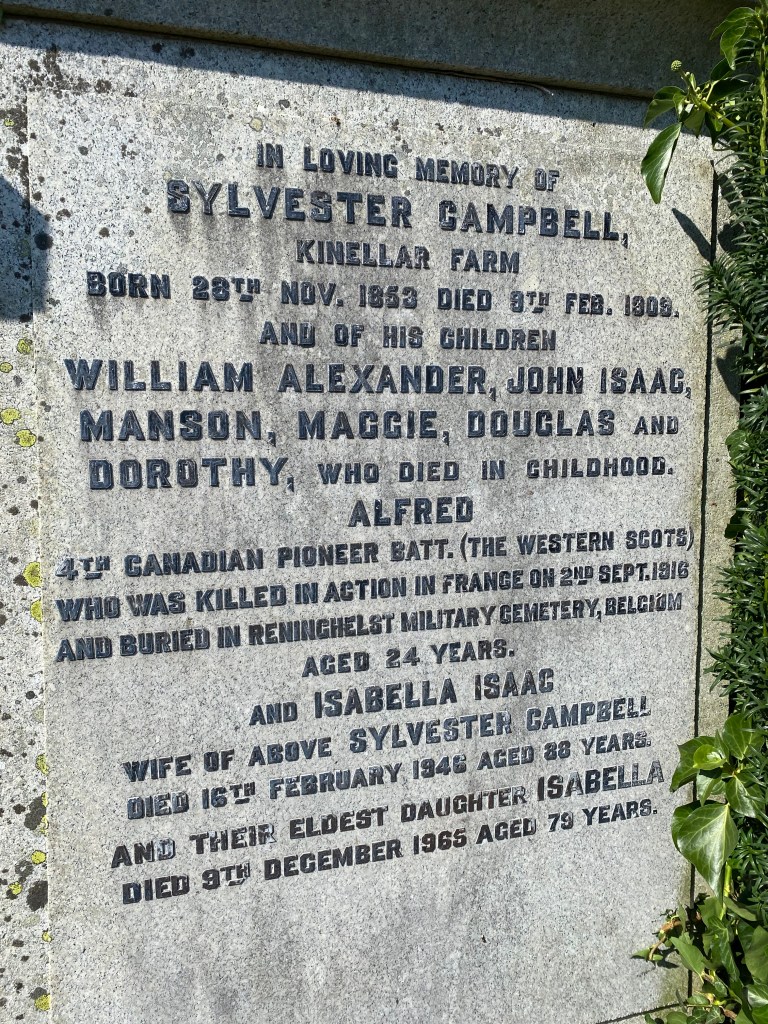
Family
Alfred Campbell was born on 25 May 1892 at Kintore, Aberdeenshire. The following family information is taken from the 1901 Census, the family memorial headstone and his Canadian Army Service Record.
His family is shown as follows :-
- Father: Sylvester Campbell, born c.1854 at Kinellar, Aberdeenshire. (Farmer)
- Mother: Isabella Isaac or Campbell, born c.1858 at Ontario, Canada.
- Brother: Sylvester, born c.1885 at Kintore, Aberdeenshire.
- Sister: Isabella, born c.1887 at Kintore, Aberdeenshire.
- Brother: Leslie G., born c.1888 at Kintore, Aberdeenshire.
- Brother: Albert, born c.1893 at Kintore, Aberdeenshire.
- Sister: Mary A., born c.1897 at Kintore, Aberdeenshire.
- Brother: Douglas, born c.1899 at Kinellar, Aberdeenshire.
Addresses
The following addresses have been ascertained for Alfred Campbell :-
- 1911: Kinellar Farm, Kinaldie, near Kinellar, Aberdeenshire.
- 1915: Bon-Accord, 845 Princess Avenue, Victoria, British Columbia, Canada.
Medals
Alfred Campbell was awarded the Victory and the British War Medal for his service in the Great War.
Memorials
Alfred Campbell is honoured and remembered on the following memorials :-
- Kinellar War Memorial, Aberdeenshire.
- Book: Bank of Montreal – Memorial of the Great War
Remarks
Alfred Campbell enlisted with the 67th Battalion (Western Scots), Canadian Expeditionary Force, in October 1915. The battalion was originally raised as an infantry unit in British Columbia but was subsequently reorganised as a pioneer battalion for service overseas. Upon arrival in England and prior to active service on the Western Front, the unit became the 67th Canadian (Pioneer) Battalion, serving as the pioneer battalion of the 4th Canadian Division.
Although Alfred enlisted with the 67th Battalion, records show that at the time of his death he was serving with the 4th Battalion, Canadian Pioneers. This indicates that he was transferred from the 67th Battalion during his military service rather than remaining with the unit after its conversion to a pioneer battalion. The exact circumstances and date of this transfer have not been established, but such movements between units were common as the Canadian Corps expanded and reorganised during the war.
The 4th Canadian Pioneer Battalion was responsible for a wide range of engineering and labour duties in support of frontline operations, including trench construction and repair, road building, wiring, and the movement of supplies. These tasks were often carried out under enemy fire and were essential to maintaining the fighting effectiveness of the Canadian Corps.
This transfer explains why contemporary accounts describe Alfred as having enlisted in the 67th Battalion, while official Commonwealth War Graves Commission records record him as serving with the 4th Battalion, Canadian Pioneers at the time of his death on 2 September 1916.
While researching Alfred’s story, I encountered differing accounts regarding the relationship between the 67th Battalion and the 4th Canadian Pioneer Battalion. Some sources suggest that the 67th Battalion became the 4th Canadian Pioneer Battalion, while others indicate that they remained separate units. Although I have been unable to locate a war diary for the 4th Canadian Pioneer Battalion covering the relevant period, the 67th Battalion continued to use its own title within its war diary. Furthermore, following Alfred’s death, the Commonwealth War Graves Commission continued to record casualties in both the 67th Battalion and the 4th Canadian Pioneer Battalion as distinct units. On the balance of the available evidence, it appears unlikely that there was a straightforward change of name or direct merger, although personnel from the 67th Battalion may have been transferred to reinforce the 4th Canadian Pioneer Battalion.
Links to Additional Information
- Canadian Service Record: Alfred Campbell
- Commonwealth War Graves Commission: Alfred Campbell.
- Find a Grave: Alfred Campbell
- A Street Near You website: Alfred Campbell.
- Lives of the First World War: Alfred Campbell.
References
- Commonwealth War Graves Commission.
- 1901 Census. (Ancestry)
- Memorial of the Great War Book – Bank of Montreal. (Archive.org)
- Daily Colonist dated 4 October 1916.
- Victoria (B.C.) Times c.1916.
- Canadian Army Service Records. (National Archive of Canada)
- Scottish National Probate Index: 1918. (Ancestry)
- Scottish National Probate Index: 1918 (Ancestry)
Groups
Contributors:-
- Vincent Stuart. (Main Story)

