British Committee of the French Red Cross, 29 December 1929

Synopsis of Life and Service
Nurse, Humanitarian and Typhus Relief Worker
Ethel Gordon Dunbar devoted her life to caring for others. During the First World War she served in Nice, caring for wounded French soldiers, before later nursing French refugees. Her dedication earned both British and French recognition.
After the Armistice, when most wartime nurses returned home, Ethel volunteered for one of the most dangerous humanitarian missions in post-war Europe, working in the disease-ridden camps of newly independent Poland. At Białystok she cared for displaced civilians suffering from disease, injury and extreme deprivation, helping to prevent the spread of typhus from Eastern Europe.
While serving there, Ethel contracted typhus herself. Although she recovered sufficiently to continue her work, the illness permanently damaged her health. She continued nursing until her untimely death from tuberculosis in 1929.
Ethel Gordon Dunbar was born on 16 March 1876 at Multan, Punjab, India (now Pakistan), into a distinguished Scottish military family. She was baptised on 6 April 1876. She was the third daughter of Lieutenant-Colonel Arbuthnott Pery Byng Sutherland Dunbar (1847–1890) and Catharina Hester Orred Dunbar (1846–1915), who married at Marshfield, Gloucestershire, on 16 April 1873.
Family and Early Life
Her father enlisted in the 92nd (Gordon Highlanders) in 1867 and rose through the ranks to become a Lieutenant-Colonel. He was also a nephew of the 6th Baron of Northfield, connecting the family to the Dunbars of Northfield in Morayshire.
The family lived at several substantial homes in the north of Scotland, including Mansion House, Newton, Alves (1881 Census), Forres House, Forres (1891), and later Aultnaskiach, Culduthel Road, Inverness (1901). By 1911 Ethel’s widowed mother was living at 16 Onslow Gardens, South Kensington.
Rather than following the conventional path expected of a woman of her social standing, Ethel chose nursing as a profession. She qualified as a nurse in 1908 and, by the 1911 Census, was employed as a professional nurse caring for Esther Jane Jackson, an elderly patient living at 57 North Bar Without, Beverley. Contemporary accounts also record that she specialised in mental nursing before the outbreak of the First World War.
First World War Service
When war broke out in August 1914, Ethel volunteered for overseas service.
During the winter of 1914 she worked in a French Military Hospital at Nice under the British Committee of the French Red Cross. At a time when the French hospital system was overwhelmed with casualties arriving from the Western Front, British volunteer nurses provided invaluable assistance treating wounded soldiers.
She subsequently joined the Society of Friends, working amongst civilian refugees displaced by the fighting. Refugee work required nurses to deal not only with injuries but also with infectious disease, malnutrition and the hardships faced by displaced populations.
In recognition of these humanitarian services, the French Government awarded Ethel the Médaille de la Reconnaissance Française, a decoration instituted to recognise civilians who had rendered exceptional service to France.
Her British service was also formally recognised. Her Medal Index records her as a nurse with the British Committee of the French Red Cross (WO 329), qualifying for both the British War Medal and the Victory Medal.
Unlike many serving nurses who worked within Queen Alexandra’s Imperial Military Nursing Service, Ethel belonged to the large body of voluntary nurses serving through the Red Cross and other relief organisations, often in difficult and dangerous circumstances away from the better-known military hospitals.
Poland and the Typhus Epidemic
For Ethel, the end of the war did not mean the end of humanitarian service.
In 1919 she volunteered with the Society of Friends for relief work in Poland, which had emerged as an independent nation after more than a century of partition. The country faced enormous challenges. Fighting continued along its eastern frontiers while millions of refugees, prisoners of war and displaced civilians suffered from famine and epidemic disease.
The Quaker relief mission had been invited by the Polish Ministry of Health to assist with sanitation, hospitals, children’s welfare and, above all, the control of typhus. Spread by lice and thriving wherever overcrowding and poverty existed, typhus devastated much of Eastern Europe during the immediate post-war years.
While serving in Poland, Ethel and her colleague, Miss Leigh, learned of the desperate conditions in the camp at Białystok. They volunteered to assist the American Red Cross until a British unit could take over.
The situation they encountered was appalling.
According to American Red Cross reports, approximately 3,000 prisoners were housed in overcrowded buildings without heating, blankets or adequate food. Medical care was almost non-existent. Around 80 per cent of the prisoners suffered from dysentery, typhus or tuberculosis, while between 30 and 50 men died each day. Many of the men had gangerene of the feet from freezing: all werebadly clothed, many almost naked, and the suffering was extreme. The filth was excessive in the quarters and in the yards about the buildings. The so-called drains were in an unspeakably filthy state.
Ethel and Miss Leigh established themselves in a small building attached to the camp and worked day and night nursing the sick while attempting to improve conditions.
Eventually, both women contracted typhus themselves.
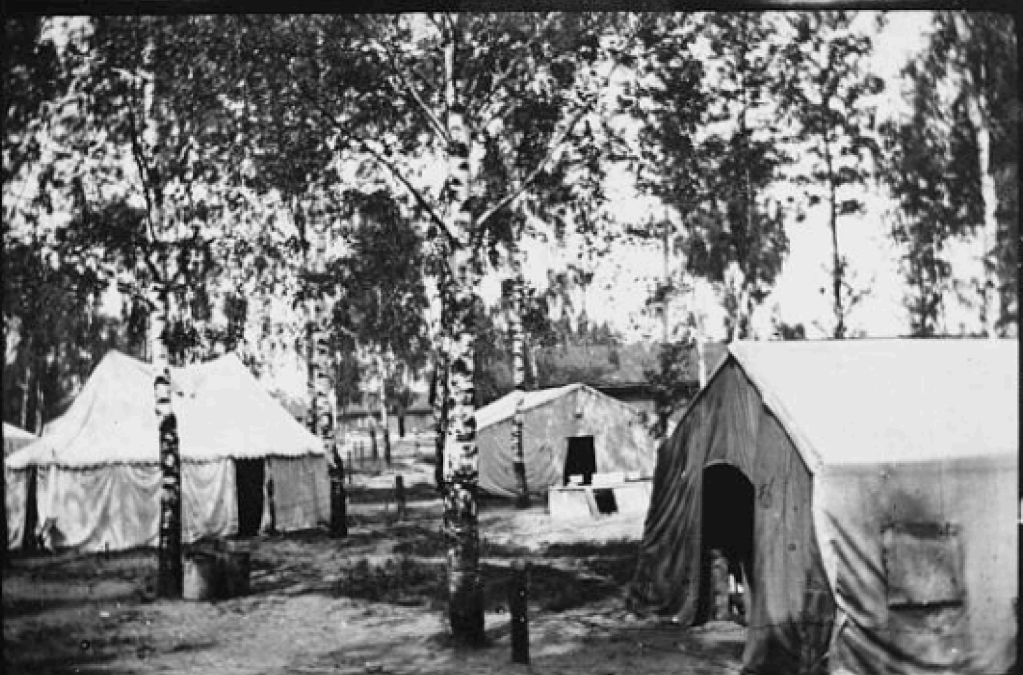
at Bialystok, Poland. (Library of Congress Prints and Photographs Division Washington, D.C.
20540 USA).
After recovering sufficiently, they returned to work despite the obvious risk to their own health. The effects, however, proved irreversible. Miss Leigh died only a few years later, while Ethel’s typhus infection was followed by tuberculosis, from which she never fully recovered. She died on 29 December 1929 at Burley, Hampshire. She was 53 years old.
Her estate was administered at London by her brother, Sir Archibald Edward Dunbar, baronet who also appears to be the beneficiary of her estate valued at £3,470, a substantial sum in 1929.
Family
Ethel Gordon Dunbar was born on 16 March 1876 at Multan, Punjab, India (now Pakistan).
The following family information has been ascertained :-
- Father: Arbuthnott Pery Byng Sutherland Dunbar, born 18 November 1847 at Dhanka, India. (now Bangladesh) (Lieutenant Colonel in British Army)(d.1890)
- Mother: Catharina Hester Orred or Dunbar, born 30 July 1846 at Liverpool.(d.1915)
- Sister: Catharina Agnes Sophie, born 17 February 1874 at Multan, now Pakistan.(d.1955)
- Sister: Ianthe Margaret Dunbar or Harrison, born 2 April 1875 at Multan, now Pakistan. (d.1952)
- Sister: Aileen Edith Dunbar or Hunter, born 27 June 1877 at Bournemouth, Dorset.(d.15/4/1952)
- Sister: Hilda Mary, born 1878 at India and died the same year.
- Sister: Marjorie Isabel Gordon, born c.1881 at Newton House, near Alves, Morayshire. (d.1941)
- Sister: Lilias Cumming, born c.1882 at Newton House, near Alves, Morayshire. (d.1976)
- Sister: Helen Penuel Dunbar or Hunt, born c.1884 at Newton House, near Alves, Morayshire.(d.1979)
- Brother: Arbuthnott John, born 6 September 1885 at Newton House, near Alves, Morayshire. (killed in action 1915)
- Brother: Archibald Edward, born 17 February 1889 at Newton House, near Alves, Morayshire. (d.1969)
Addresses
Records show that Ethel lived in:
- 1881: Newton House, near Alves, Morayshire. (Census)
- 1891: Forres House, Urquhart Street, Forres, Morayshire. (Census)
- 1901: Aultnaskiach House, Culduthel Road, Inverness. (Census)
- 1911: 57 North Bar Without, Beverley, East Riding, Yorkshire. (Census)
- 1926: 11 Mecklenburgh Street, London W.C. (The Nurses Roll)
- 1929: Little Bisterne, Burley, Hampshire. (National Probate)

Medals
Ethel Gordon Dunbar was awarded the Victory and the British War Medals for her service in the Great War. She was also awarded the Médaille de la Reconnaissance Française (France)(3rd Class), a decoration instituted to recognise civilians who had rendered exceptional service to France.

Memorials
There was no trace of Ethel Dunbar on any war memorial. She is however honoured in the book :-
Remarks
Ethel’s brothers and sisters gave distinguished service to their country during the Great War. Their roles were as follows:-
- Lilias was a driver for the Y.M.C.A. and was involved in hospital work.
- Marjorie was a Lady Manager at a Munition Works.
- Catharina served in the French Hospitals at Nice and Grenoble.
- Arbuthnott was a Captain in the Royal Field Artillery, he joined in 1905, served in India and France and was killed in action on 17 March 1915 near Neuve Chapelle, France.
- Archibald was a Major in the 12th West Yorkshire Regiment, joining in London on 31 August 1914 and served in France. He was awarded the Military Cross.
Links to Additional Information
- Find a Grave website: Ethel Gordon Dunbar.
- Lives of the First World War: Ethel Gordon Dunbar.
- Report on The British Committee of the French Red Cross.
References
- The Morayshire Roll of Honour (1921)
- Burke’s Peerage, Baronetage & Knightage, 107th Edition.
- The Passing Bell, vol 78. (February 1930), obituary of Miss Ethel Gordon Dunbar.
- WO 76: War Office: Records of Officers’ Services, (The National Archives, Kew.)
- UK Officer Service Records, 1764–1932. (Ancestry)
- London Gazette, Issue 27874, 8 January 1906.
- The Belfast News-Letter, dated 20 March 1874.
- The Midwives Roll – 1926. (Ancestry)
- National Probate Calendar. (Ancestry)
- Moray LIBINDX website.
- Census: 1881. (Ancestry)
- Census: 1891. (Find My Past)
- Census: 1901. (Ancestry)
- Census: 1911. (Ancestry)
- British India Office Births & Baptisms. (Find My Past)
- Inverness Courier dated 10 January 1930, page 6. (British Newspaper Archive)
Groups
Contributors:-
- Sasha Cameron (Main Article)

